Own your context layer, on the stack you already run
Your ontology, pipelines and business logic should be yours. Data Workers rebuilds them on your own warehouse, dbt project and governed context layer, runs side by side with Foundry and moves one workflow at a time.
Before and after
| Today | With Data Workers |
|---|---|
| Ontology and logic inside a vendor platform | Governed definitions and lineage in your own context layer |
| Data replicated into their environment | Data read in place in your cloud |
| Pipelines in a proprietary builder | Pipelines as reviewed dbt and SQL |
| Leaving means starting from zero | Leave any vendor and keep everything |
How it works
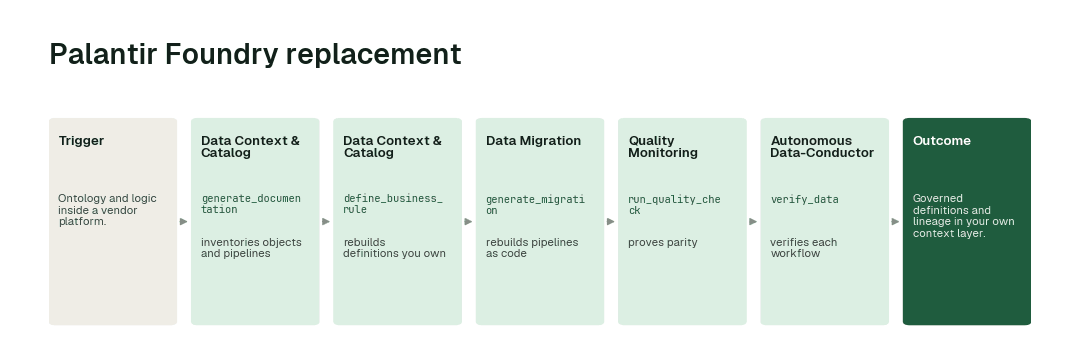
1. Map what Foundry runs
Data Context & Catalog inventories object types, links, pipelines and the consumers of each workflow.
2. Rebuild on your stack
Object types and metrics become governed definitions in Data Context Wizard; Pipeline Building and Data Migration rebuild pipelines as tested code on your warehouse.
3. Run side by side, then switch
Quality Monitoring proves parity for each workflow; once consumers move, the Foundry workflow is retired.
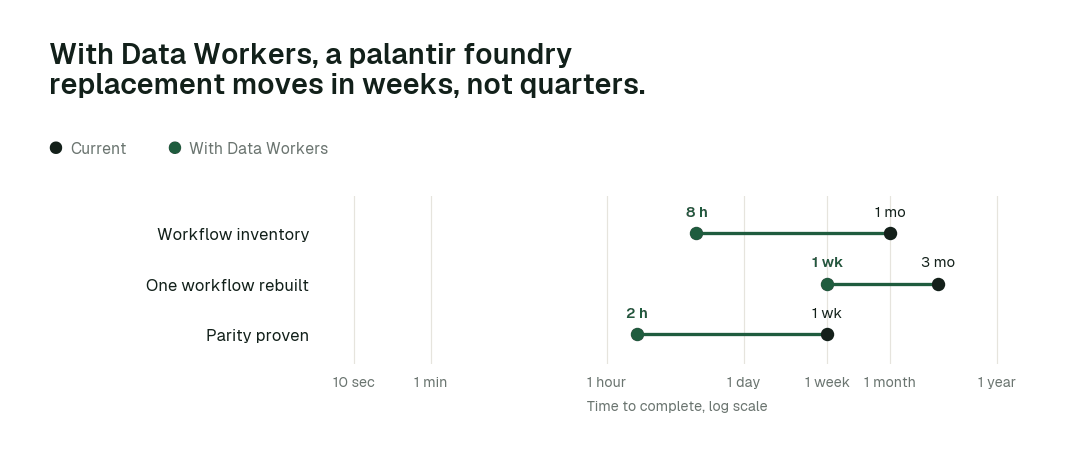
The impact metrics we move
- •Workflow inventory: from about a month to 8 h
- •One workflow rebuilt: from about 3 months to 1 wk
- •Parity proven: from about a week to 2 h
Where teams start
- •Ontology into governed definitions. Objects, links and metrics in a context layer you own.
- •Pipelines without a proprietary builder. Reviewed code on your warehouse.
- •Agents on your permissions. AI tools act through your access controls with receipts.
- •Health plans and payors. Claims, members and providers modeled as your IP.
- •Regulated estates. Everything stays inside your cloud.
The climb: from assisted to autonomous to agentic
Every transformation runs on the same ladder from our thesis: agents first inventory and propose with receipts, then move work in approved waves, and the finished platform keeps running itself once the move is done.
The pilot
- •Scope. Rebuild one Foundry workflow on your stack and run it side by side.
- •First week. Agents run at L1, observing only, and show the fixes they would have made, with receipts.
- •By week two. The routine work above runs on its own; anything sensitive stays with a named approver.
- •At day 30. We review the impact metrics against your baseline:
- •Workflow inventory: from about a month to 8 h
- •One workflow rebuilt: from about 3 months to 1 wk
- •Parity proven: from about a week to 2 h
- •Cost. Start with a pilot ($7,500 one-time, credited in full against the first year). Scale is from $1,000 a month and Enterprise from $3,000 a month, billed annually, with unlimited seats, no usage meter and no markup on model spend. See pricing.
FAQ
Do we have to rip Foundry out? No; one workflow moves first and runs side by side.
Can we keep our object model? Yes; it becomes governed definitions you own.
Where does our data live? In your cloud; agents run in your infrastructure.