Move from legacy schedulers to modern orchestration without a freeze
Control-M, Autosys and aging Airflow deployments hold thousands of jobs nobody wants to migrate. Data Workers maps every job and dependency, moves them in waves and verifies every SLA.
Before and after
| Today | With Data Workers |
|---|---|
| Thousands of jobs in a legacy scheduler | Every job and dependency mapped |
| Dependencies nobody can draw | Jobs moved in reversible waves |
| Upgrades postponed for years | SLAs verified through the move |
| Freezes for every migration | No freeze |
How it works
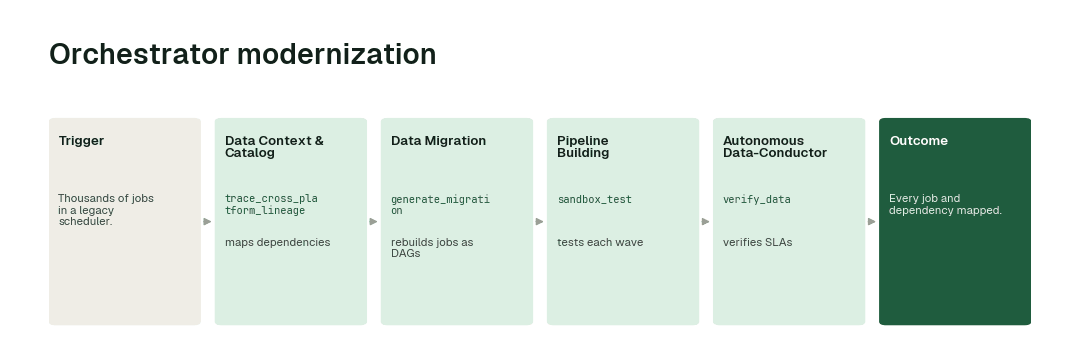
1. Map every job
Data Context & Catalog maps jobs, schedules and dependencies.
2. Move in waves
Data Migration rebuilds jobs as DAGs in the target orchestrator, wave by wave.
3. Verify SLAs
Conductor watches every SLA and rolls back any wave that drifts.
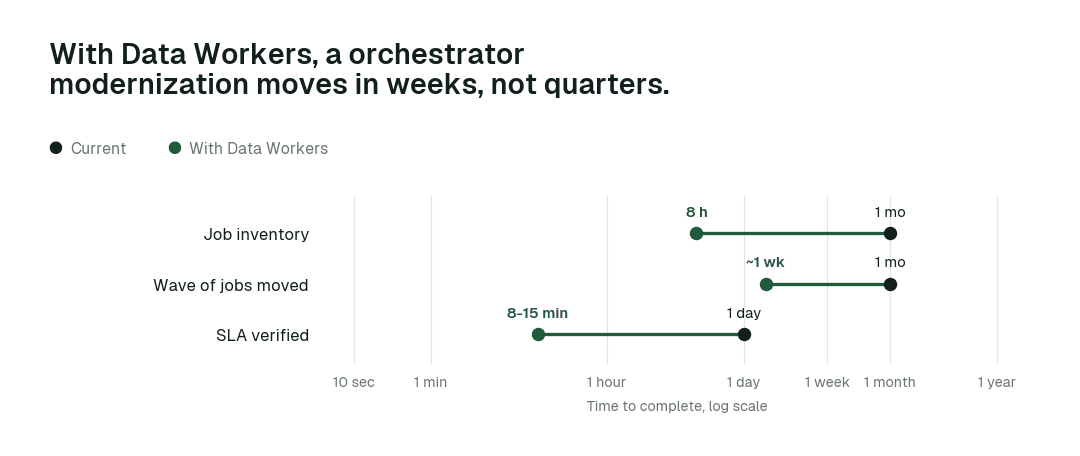
The impact metrics we move
- •Job inventory: from about a month to 8 h
- •Wave of jobs moved: from about a month to ~1 wk
- •SLA verified: from about a day to 8-15 min
Where teams start
- •Control-M and Autosys to Airflow or Dagster. Jobs rebuilt as DAGs.
- •Airflow 2 to 3. Upgrades without a freeze.
- •Cron and scripts. Consolidated under one orchestrator.
- •Cross-team dependencies. Drawn and enforced.
- •SLA monitoring. Verified on every run.
The climb: from assisted to autonomous to agentic
Every transformation runs on the same ladder from our thesis: agents first inventory and propose with receipts, then move work in approved waves, and the finished platform keeps running itself once the move is done.
The pilot
- •Scope. Map the estate and move one wave of jobs.
- •First week. Agents run at L1, observing only, and show the fixes they would have made, with receipts.
- •By week two. The routine work above runs on its own; anything sensitive stays with a named approver.
- •At day 30. We review the impact metrics against your baseline:
- •Job inventory: from about a month to 8 h
- •Wave of jobs moved: from about a month to ~1 wk
- •SLA verified: from about a day to 8-15 min
- •Cost. Start with a pilot ($7,500 one-time, credited in full against the first year). Scale is from $1,000 a month and Enterprise from $3,000 a month, billed annually, with unlimited seats, no usage meter and no markup on model spend. See pricing.
FAQ
Do we need a freeze? No; waves are small.
What about cross-team dependencies? They are mapped before anything moves.
What if a wave misses an SLA? It rolls back automatically.