Cut warehouse and compute spend without missing an SLA
Platform spend grows faster than usage because nobody can prove what is safe to touch. Data Workers finds waste, proves dependencies, changes in waves and verifies every SLA.
Before and after
| Today | With Data Workers |
|---|---|
| Spend that grows every quarter | Spend that falls with every SLA met |
| Cleanups abandoned for fear of breaking things | Lineage proves what is safe first |
| Full refreshes and oversized clusters | Incremental models and right-sized compute |
| No owner for most of the bill | Cost visible per data product |
How it works
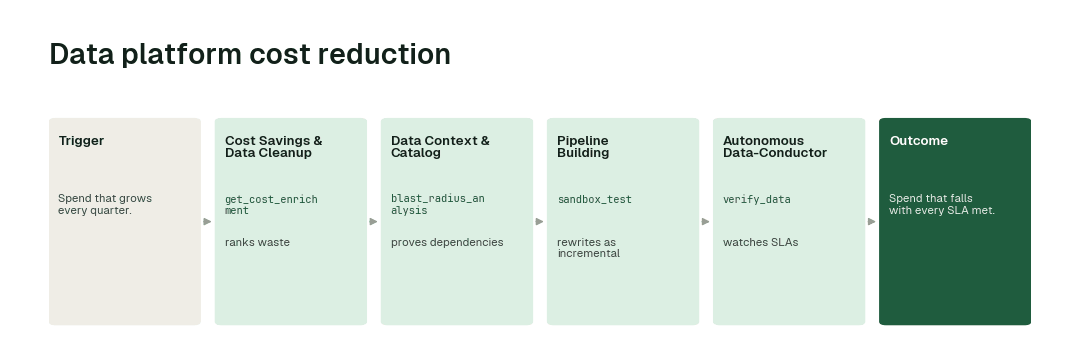
1. Find the waste
Cost Savings & Data Cleanup ranks unused tables, duplicate sandboxes, full refreshes and oversized compute.
2. Prove what depends on it
Data Context Wizard checks every consumer before anything changes.
3. Change in waves and verify
Changes ship in reversible waves; Quality Monitoring proves parity and Conductor watches every SLA.
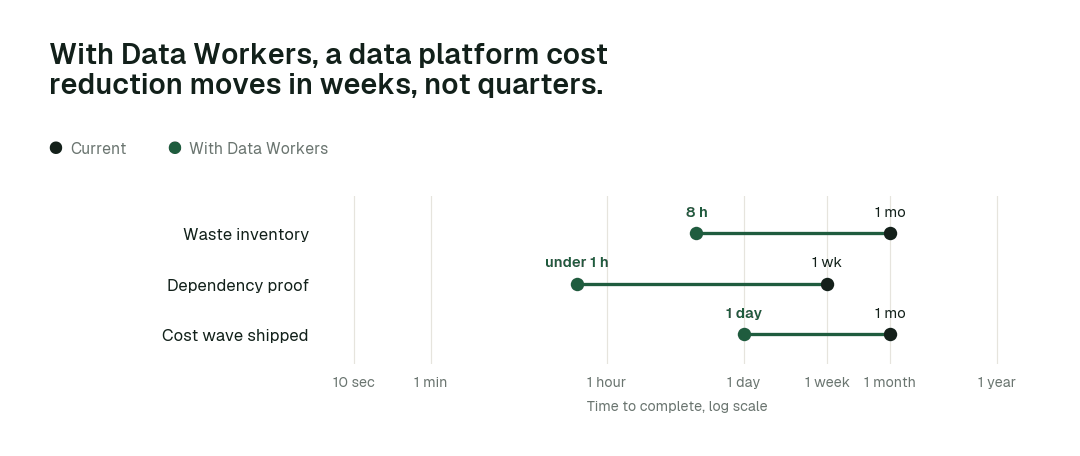
The impact metrics we move
- •Waste inventory: from about a month to 8 h
- •Dependency proof: from about a week to under 1 h
- •Cost wave shipped: from about a month to 1 day
Where teams start
- •Snowflake and Databricks spend. Right-size warehouses and clusters.
- •Dead tables and sandboxes. Retire with snapshots.
- •Full refreshes to incremental. Rebuild with parity.
- •Schedules matched to use. Stop hourly jobs for weekly dashboards.
- •Cost per data product. Show owners their spend.
The climb: from assisted to autonomous to agentic
Every transformation runs on the same ladder from our thesis: agents first inventory and propose with receipts, then move work in approved waves, and the finished platform keeps running itself once the move is done.
The pilot
- •Scope. A cost mission on one domain.
- •First week. Agents run at L1, observing only, and show the fixes they would have made, with receipts.
- •By week two. The routine work above runs on its own; anything sensitive stays with a named approver.
- •At day 30. We review the impact metrics against your baseline:
- •Waste inventory: from about a month to 8 h
- •Dependency proof: from about a week to under 1 h
- •Cost wave shipped: from about a month to 1 day
- •Cost. Start with a pilot ($7,500 one-time, credited in full against the first year). Scale is from $1,000 a month and Enterprise from $3,000 a month, billed annually, with unlimited seats, no usage meter and no markup on model spend. See pricing.
FAQ
Will it delete data? Only at the level you set, with snapshots.
How do we see savings? Spend before and after on the Autopilot dashboard.
What about SLAs? Conductor rolls back any change that misses one.