Private equity portfolio data teams: less upkeep, more data products
Less upkeep, more data products. Most of the week on private equity portfolio data teams goes to upkeep: broken feeds, reruns, access queues and documentation. Data Workers hands that work to agents so the team ships the data products the business has been asking for.
Key takeaways
- •Who this is for. Data leaders and teams at private equity firms and their portfolio companies.
- •The problem today. Portfolio operations teams spend their month collecting and reconciling instead of creating value.
- •What changes. Data Workers connects to each company where its data lives, maps it to one governed KPI model, checks every submission and runs post-acquisition integration as a mission.
- •What stays with your people. Anything that moves money, a filing or a regulated number waits for a named approver.
- •The result. Teams spend their time on private equity decisions, not on reconciling data.
The shift
Private equity firms run on data from companies they do not control: different ERPs, charts of accounts and reporting habits. Portfolio operations teams spend their month collecting and reconciling instead of creating value.
Data Workers connects to each company where its data lives, maps it to one governed KPI model, checks every submission and runs post-acquisition integration as a mission.
The use cases we run in private equity
- •[Portfolio intelligence data](/use-cases/portfolio-intelligence/). The deal team sees comparable KPIs across the portfolio every month.
- •[Value creation tracking data](/use-cases/value-creation-tracking/). Value creation is tracked on live operating data.
- •[Post-acquisition data integration](/use-cases/post-acquisition-transformation/). Integration hits the 100-day plan with every number proven.
- •[Due diligence data](/use-cases/due-diligence/). Diligence analysis starts on day two, not week three.
- •[Portfolio company reporting data](/use-cases/portfolio-company-reporting/). Monthly reporting closes on time across the portfolio.
Teams we work with in private equity
Each team has a full playbook and a best-practice report.
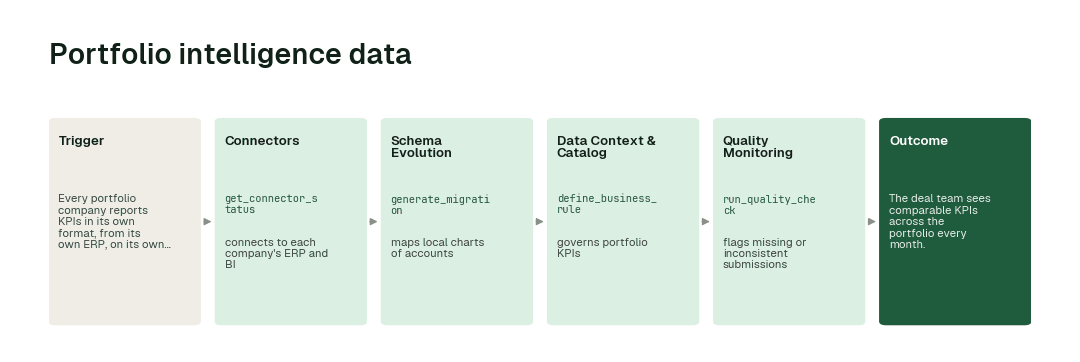
A workflow, end to end: portfolio intelligence data
Agents land each company's data where it lives, map it to one governed KPI model and flag gaps before the monthly review.
The impact metrics we move
- •Portfolio KPI pack: from about 2 weeks to 8 h (portfolio intelligence data)
- •Initiative scorecard: from about 2 weeks to 4 h (value creation tracking data)
- •Estate inventory: from about a month to 1 day (post-acquisition data integration)
- •Data room profiled: from about a week to 4 h (due diligence data)
- •Pack collected and mapped: from about a week to 2 h (portfolio company reporting data)
The climb: from assisted to autonomous to agentic
Our thesis is that the data platform climbs in stages. In private equity: agents first assist, proposing every fix with a receipt; then routine verification, mapping and reconciliation run on their own under your governance; and finally the back office largely runs itself while people set direction.
The pilot
- •Scope. One use case from the list above, on one line of business.
- •First week. Agents run at L1, observing only, and show the fixes they would have made, with receipts.
- •By week two. The routine work above runs on its own; anything sensitive stays with a named approver.
- •At day 30. We review the impact metrics against your baseline:
- •Portfolio KPI pack: from about 2 weeks to 8 h
- •Initiative scorecard: from about 2 weeks to 4 h
- •Estate inventory: from about a month to 1 day
- •Cost. Start with a pilot ($7,500 one-time, credited in full against the first year). Scale is from $1,000 a month and Enterprise from $3,000 a month, billed annually, with unlimited seats, no usage meter and no markup on model spend. See pricing.