Upriver vs Data Workers: Your Data Never Leaves the United States
Upriver is an Israeli company whose default SaaS stores metrics and samples of your data in its own cloud. Data Workers is a New York company whose agents run in your environment, so your data never leaves the United States.
If you run data for a US company, the first question your security reviewer asks about an AI data engineering platform is where the bytes go and who can reach them. Upriver and Data Workers answer that question differently, and the difference is structural.
Upriver is a strong product. It connects to your warehouse, orchestrator and code, builds a living map of your stack, and runs an agent loop that plans, executes and validates work with a mandatory human sign-off. On that loop it is the closest peer we have, and our Agentic Data Engineering Index says so cell by cell.
It is also a company registered in Israel, Upriver Data Ltd., headquartered in Ramat Gan, and its default deployment is a SaaS that runs in Upriver's own cloud. In that mode Upriver's cloud assumes a read-only role in your warehouse, and its docs say the extracted metrics and "a small number of samples" of your data are stored on Upriver's side. Its privacy policy says personal data is transferred to affiliates and service providers "many of whom are located outside of your jurisdiction".
Data Workers, Inc. is a US company based in New York, and the agents run in your environment on every tier. Your rows, your credentials and your model keys never leave your infrastructure, so they never leave the country. Data Workers is the agentic data platform: a catalog that works as the control plane, one context graph across the estate, a loop that detects, diagnoses, fixes, reviews and verifies, and autonomy set per domain, with a receipt on every change. This page is about one part of that: residency, jurisdiction and who holds the bytes.
Key takeaways
- •Upriver Data Ltd. is registered in Israel. Its press release is datelined San Francisco; its company registration and headquarters are in Ramat Gan, Israel. Its contracts, staff and privacy policy sit under that jurisdiction.
- •Upriver's default SaaS runs in Upriver's cloud. Per its architecture docs, "all of Upriver's components are deployed in Upriver's cloud environment", on AWS in us-east-1 or eu-west-1, and extracted metrics plus samples of your data are stored there.
- •Data Workers runs in your environment on every tier. Inside the coding agent your engineers already use on Start and Scale, and in your VPC, your own cloud, on-premise or air-gapped on Enterprise. Nothing we operate sits between your agents and your warehouse.
- •The one hosted component sees workflow metadata only. The Autonomous Data-Conductor receives goals, signals, table names, proposals and run records, never rows, credentials or model keys. It is operated by a New York company, and an air-gapped install sends it nothing.
- •Your model is yours. Calls go to a provider account you hold the key for, in the region you choose, or to Ollama or vLLM on your hardware. Sovereign mode blocks every external model call.
- •Upriver offers a hybrid mode. It keeps the data plane in your environment while Upriver's cloud service stays in Upriver's environment. It is a real option, and it still leaves the control plane and the contract under Israeli jurisdiction.
Where your data goes
Residency is a question about paths, so here are the paths, each one from the vendor's own pages.
Upriver, SaaS mode. This is the deployment the AWS Marketplace listing sells and the first one its docs describe. Upriver's cloud service assumes a read-only role you create in your environment. Its data analyzer runs in Upriver's cloud and writes the extracted metrics, plus a small number of row samples used for root-cause analysis, into Upriver's object storage. Outbound traffic to your warehouse comes from Upriver's AWS account in us-east-1 or eu-west-1, and the network page lists the IPs to allowlist. The people who operate that cloud, and the company that signs your contract, are in Israel.
Upriver, hybrid mode. The data plane, meaning the metadata storage and the analyzer engine, runs in your environment, and the docs state that in this mode no data leaves the client environment. Upriver's cloud service, the part that is not the data plane, still runs in Upriver's environment, and PrivateLink, VPC peering or a VPN to it is arranged with your Upriver representative.
Data Workers, every tier. The agents run in your infrastructure. On Start and Scale that means inside Claude Code, Cursor, Codex or another MCP-compatible coding agent, on your engineers' machines or your build hosts. On Enterprise it means a dedicated VPC, your own cloud, on-premise or air-gapped, agreed in writing at contract. The agents hold your warehouse credentials and your model key, query your data in place through the grants you give them, and write the context graph, the receipts and the audit log inside your deployment. There is no Data Workers cloud that your warehouse traffic passes through.
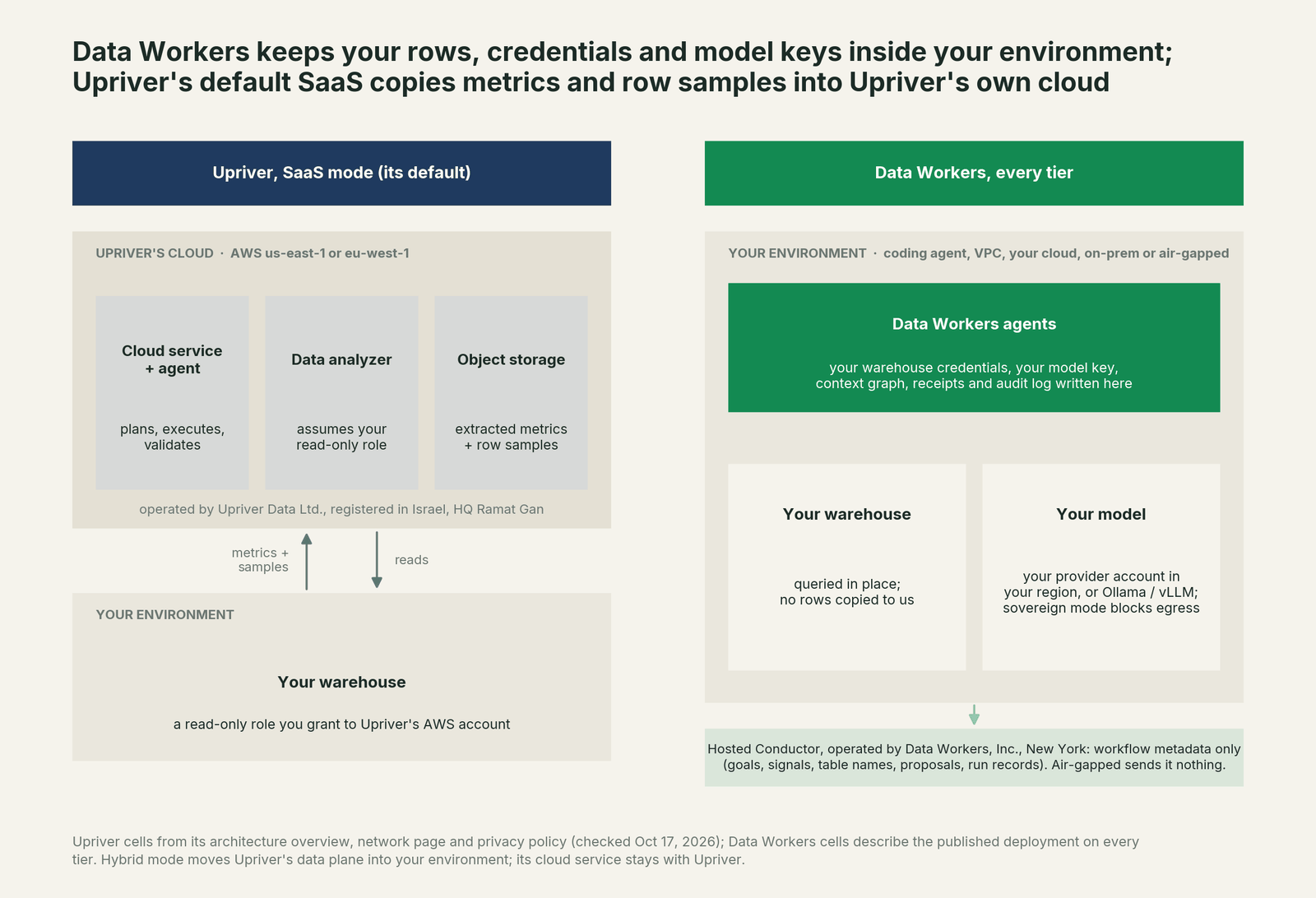
The one component we host. The Autonomous Data-Conductor is the orchestration layer. It turns a goal such as "every table is documented" into routines, dispatches work to the agents in your environment, and records each run. It has no warehouse connector and never queries your warehouse. What crosses the boundary to it is workflow metadata: goals, detected signals, the names of the tables involved, proposals with their description and diff, run records and approval handles. It is operated by Data Workers, Inc., a US company, from New York. On Enterprise, US-only hosting and US-only operator access for that metadata is a written commitment, and an air-gapped install runs its own Conductor and sends us nothing at all.
Your model. Prompts and responses go to the model account you hold the key for, Anthropic, OpenAI or another provider, under your agreement with that provider and in the region you pick there. Or they go to Ollama or vLLM on your own hardware. In sovereign mode every external model call is blocked, there is no fallback to a cloud provider, and a network guard logs every outbound request it stops. Where does our data go walks every component and boundary; in your VPC or air-gapped covers the three deployment shapes end to end.
What "never leaves the United States" means, line by line
| Question a reviewer asks | Upriver, SaaS mode (its docs, Oct 2026) | Data Workers |
|---|---|---|
| Who is the vendor, and under whose law? | Upriver Data Ltd., registered in Israel, HQ Ramat Gan | Data Workers, Inc., a US company, New York |
| Where do the agents run? | In Upriver's cloud environment, on AWS | In your coding agent or your VPC, your cloud, on-premise or air-gapped |
| How does the vendor reach the warehouse? | Upriver's cloud assumes a read-only role in your environment | It does not. Your agents hold your credentials inside your environment |
| Are rows of our data stored by the vendor? | Yes. Extracted metrics and "a small number of samples" in Upriver's object storage | No. Rows are queried in place and never stored by us |
| Where do our credentials live? | A role your environment grants to Upriver's AWS account | In your environment, never with us |
| Where do model calls go? | Not stated in the public docs | Your provider account in your region, or a local model; sovereign mode blocks external calls |
| What does the vendor's hosted service receive? | Metrics, samples and the metadata its map is built from | Workflow metadata only: goals, signals, table names, proposals, run records |
| Can it run with no path out at all? | Hybrid keeps the data plane local; the cloud service stays with Upriver | Yes. The air-gapped install sends us nothing |
| What does the privacy policy say about transfers? | Personal data goes to affiliates and providers "many of whom are located outside of your jurisdiction" | We are based in the United States and the agents never send us your data |
Two of those rows do the work. Upriver's cloud holds a role into your warehouse and a copy of samples from it. Data Workers holds neither. Everything after that, certifications, questionnaires, penetration tests, is about how well a vendor protects what it holds. We would rather hold nothing.
Why this is a procurement question before it is a security question
None of this is a comment on Upriver's engineering. It publishes a trust center and a security page, and we link to both below. Jurisdiction is a separate question, and for a US buyer it comes up in four places.
Third-party risk programs. The 2023 interagency guidance on third-party relationships from the OCC, the Federal Reserve and the FDIC treats a foreign-based third party, one "whose servicing operations are located in a foreign country and subject to the law and jurisdiction of that country", as a factor in its own right. It tells banks to weigh choice-of-law and jurisdictional provisions, warns that such contracts "may be subject to the interpretation of foreign courts", suggests legal advice on enforceability "including privacy laws and cross-border flow of information", and asks about the geographic location of subcontractors and their data. If you are a bank, a lender or an insurer, a vendor registered abroad adds a workstream to the review. A vendor that holds none of your data and runs inside your boundary shortens it. Data Workers for financial services covers the rest of that review.
Export-controlled and government data. Technical data under ITAR and controlled unclassified information under DFARS and CMMC come with conditions on who can access them and where they sit. Analytics estates in defence supply chains, aerospace and energy routinely hold both. Enterprise runs on-premise or air-gapped, the agents hold your credentials inside your enclave, and sovereign mode blocks external model calls. Your assessor decides what that satisfies; the architecture is built so the answer is checkable.
Customer contracts and BAAs. Many enterprise contracts, and many healthcare business associate agreements, restrict offshore access to the data they cover. If your customers' terms say their data stays in the United States, your vendors have to say the same thing, and prove it. With Data Workers the proof is the deployment itself.
Who you can reach, and when. When a pipeline breaks at 9 a.m. in New York, the people who built the platform are at their desks in New York. Support, escalation and the contract run in one time zone and one legal system. That is a small thing until the day it is the only thing.
Beyond residency: the same loop, governed
Residency is why a US buyer can start the conversation. The loop is why they finish it.
Both products run an agent loop with a human gate. Upriver's loop investigates, plans, executes and validates, and nothing ships without sign-off; its per-change validation report, with queries run, rows sampled and before and after metrics, is the most legible receipt in the category and we say so. Data Workers runs the same loop across the whole estate, and governs it per domain:
- •Autonomy is set per domain on the L0 to L4 ladder, from observe to autonomous. New deployments start at L1, observe. No agent approves its own work, and a named person approves anything irreversible.
- •Every change carries a receipt: the diff, the approver, the blast radius and the rollback path, written into your audit log, inside your deployment.
- •One context graph across clouds. The Data Context Wizard keeps schemas, lineage, owners, quality signals and approved facts in one graph spanning Snowflake, Databricks, BigQuery, dbt, Airflow and your BI tools, with source, author and time on every fact.
- •A catalog that works as the control plane. Spellbook Data Catalog, in preview, is where every proposed change from every agent lands to be approved, steered, sent back or rolled back.
- •Every agent is an MCP server. Your coding agent, your other agents and your own scripts can call Data Workers tools directly. Upriver is reachable through Claude and Cursor and documents no MCP server of its own.
- •The back office. Access requests behind approvals, warehouse spend traced to the model behind it, legacy migrations planned in waves and parity-checked, and audit evidence built from receipts.
For the lane-by-lane grading with a citation on every cell, see Data Workers vs Upriver in the Index.
What Upriver publishes about where your data goes, as of October 2026
| Topic | What Upriver says | Where |
|---|---|---|
| Legal entity | "Upriver Data Ltd., and our affiliates" | Privacy policy |
| Registration and HQ | Israeli company, Ramat Gan, Israel; founded January 2024 by Ido Bronstein and Omri Lifshitz | Startup Nation Central company page |
| Funding | $14M seed, June 2026, led by Valley Capital Partners and Hetz Ventures; press release datelined San Francisco | Upriver blog |
| Delivery | "Software as a Service (SaaS)", "Deployed on AWS: Yes" | AWS Marketplace listing |
| SaaS architecture | "all of Upriver's components are deployed in Upriver's cloud environment"; a read-only role in the client's environment assumed by Upriver's cloud service; extracted metrics and "a small number of samples" stored in Upriver's object storage | Architecture overview |
| Hybrid architecture | "the entire data plane (metadata storage and data analyzer engine) resides in the customer's environment"; Upriver's cloud service stays in Upriver's environment | Architecture overview |
| Regions | SaaS egress IPs listed for us-east-1 and eu-west-1; PrivateLink, VPC peering or VPN "arranged with your Upriver representative" | Network page |
| International transfers | Personal data is transferred "to certain countries around the world, including to our affiliates and service providers, many of whom are located outside of your jurisdiction"; no countries named, no governing law stated | Privacy policy |
| Subprocessors | AWS, MongoDB, Mixpanel, Coralogix, Descope | Trust center |
| Pricing | Not published; the pricing URL returned 404 | upriverdata.com |
Everything in that table is quoted from a page Upriver controls. If any of it changes, write to us and we will update this page.
Common questions
Does Data Workers ever hold our data? No. The agents run in your infrastructure with your credentials and your model key, query your warehouse in place and write the context graph, receipts and audit log inside your deployment. The hosted Autonomous Data-Conductor receives workflow metadata only, and an air-gapped install sends it nothing. The security page lists every component and what crosses each boundary.
What exactly does the hosted Conductor receive, and where is it operated from? Goals, detected signals, the names of the tables involved, proposals with their description and diff, run records and approval handles. Never rows, credentials or model keys. It is operated by Data Workers, Inc. from New York; on Enterprise, US-only hosting and US-only operator access for that metadata is a written commitment, and the air-gapped install runs its own Conductor inside your boundary.
Doesn't Upriver's hybrid mode solve the same problem? It moves the data plane into your environment, which is the right direction, and Upriver's docs say no data leaves the client environment in that mode. Three things stay the same: Upriver's cloud service still runs in Upriver's environment, the company is still registered in Israel, and the privacy policy's transfer clause still applies. SaaS, with everything in Upriver's cloud, is the mode the Marketplace listing sells and the first one its docs describe.
We already use Upriver. Can we add Data Workers? Yes. The two meet in git and in the warehouse. Data Workers reviews any pull request against the estate, whoever or whatever opened it, and runs the loop after the merge. There is no Upriver connector to install and nothing of yours is copied to us in the process.
Can it run with no internet connection at all? Yes. The air-gapped install ships as an offline bundle with checksums, runs on your Kubernetes cluster with Postgres and MinIO inside it and a local model through Ollama or vLLM, and turns on sovereign mode, which blocks every external model call and never falls back to a cloud provider.
What about our model provider? Yours, on your account, in your region. Data Workers is bring-your-own-model-key: prompts go to Anthropic, OpenAI or another provider under your agreement with them, and we do not mark up or meter model spend. Pick a US region at your provider and the model path stays in the country too.
How much does Data Workers cost? Scale from $1,000 a month and Enterprise from $3,000 a month, billed annually, with a $7,500 one-time pilot credited in full against your first year. Seats are unlimited and there is no usage meter. Upriver does not publish a price. See pricing.
Is Data Workers open source? The core is Apache 2.0 and free to run, and each agent is an MCP server. The open-source core runs entirely on your machine and sends nothing to us. The platform adds the Conductor, governed writes and Spellbook.
Sources
Upriver, checked October 17, 2026: architecture overview, security and compliance, network, privacy policy, trust center, about, funding announcement, AWS Marketplace listing, Startup Nation Central company page, SiliconANGLE on the raise.
Data Workers: security, pricing, where does our data go, in your VPC or air-gapped, SOX, HIPAA, GDPR and the EU AI Act, Data Workers vs Upriver in the Agentic Data Engineering Index.
Regulatory references: Interagency Guidance on Third-Party Relationships: Risk Management, OCC, Federal Reserve and FDIC, Federal Register, June 9, 2023 (foreign-based third parties, choice of law, subcontractor location); ITAR, 22 CFR Part 120; DFARS 252.204-7012 on safeguarding covered defense information.