Best practices for agentic retail data products: a field guide for retail media and insights teams
When a retailer sells its data, suppliers become customers and every number is a product feature. This report covers how retail data teams run transaction data products with an agentic back office.
The largest retailers now run data businesses. Retail media networks, supplier insights portals and clean-room collaborations turn loyalty-linked transactions into revenue, and some have spun them into subsidiaries with their own P&L.
That changes what quality means. A wrong number in an internal dashboard costs a meeting; a wrong number in a supplier portal costs a renewal. Yet most retail data products still run on a maintenance model built for internal reporting.
The teams that win run their data products like products: tied out, governed and onboarded automatically, with people focused on what to sell next.
The old world
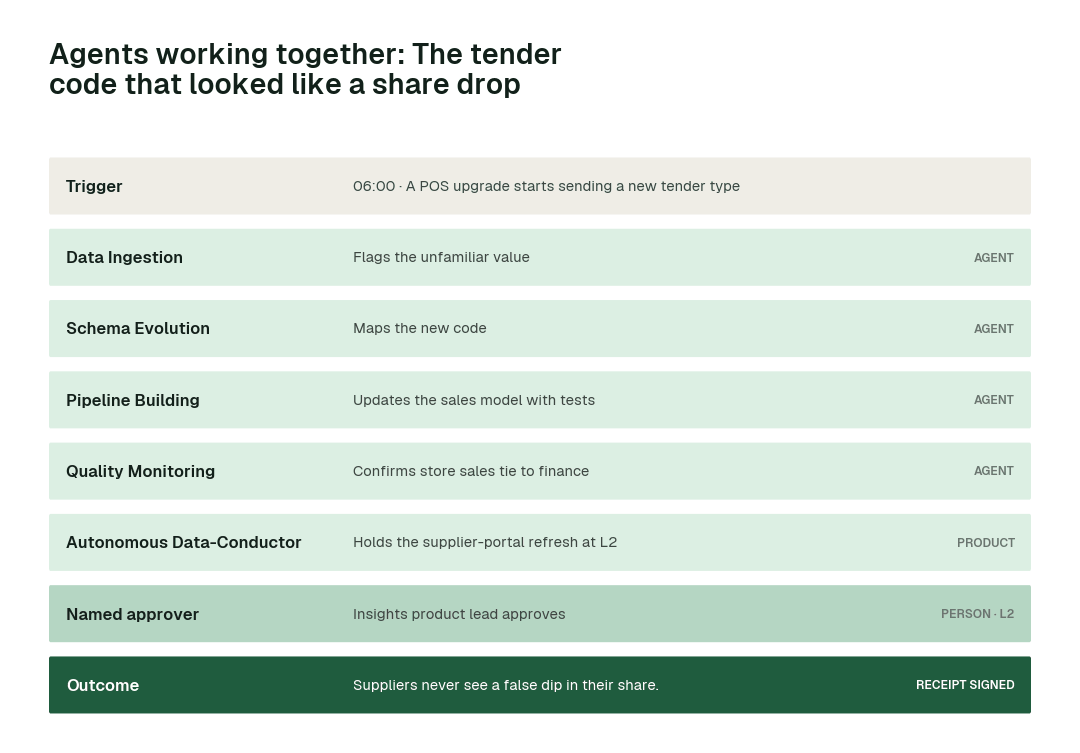
A store-system upgrade in 300 stores starts sending a new tender type. Sales drop 4% in the warehouse. The supplier portal refreshes at 6am and three brands email their account teams by 10am. The data team spends two days proving it was data. Meanwhile 40 brands wait to be onboarded, each needing scoped access and a clean-room template.
The new world
With Data Workers, the new tender code was flagged on the first load, mapped and tied to finance before the portal refreshed. Brand onboarding runs as a mission: scoped access, templates and documentation per brand, reviewed in batches. Aggregation thresholds are enforced in the pipeline, so nothing publishes that should not.
Here is that new world as a chain of hand-offs between agents:
The full playbook walks through this scenario and three more use cases in depth.
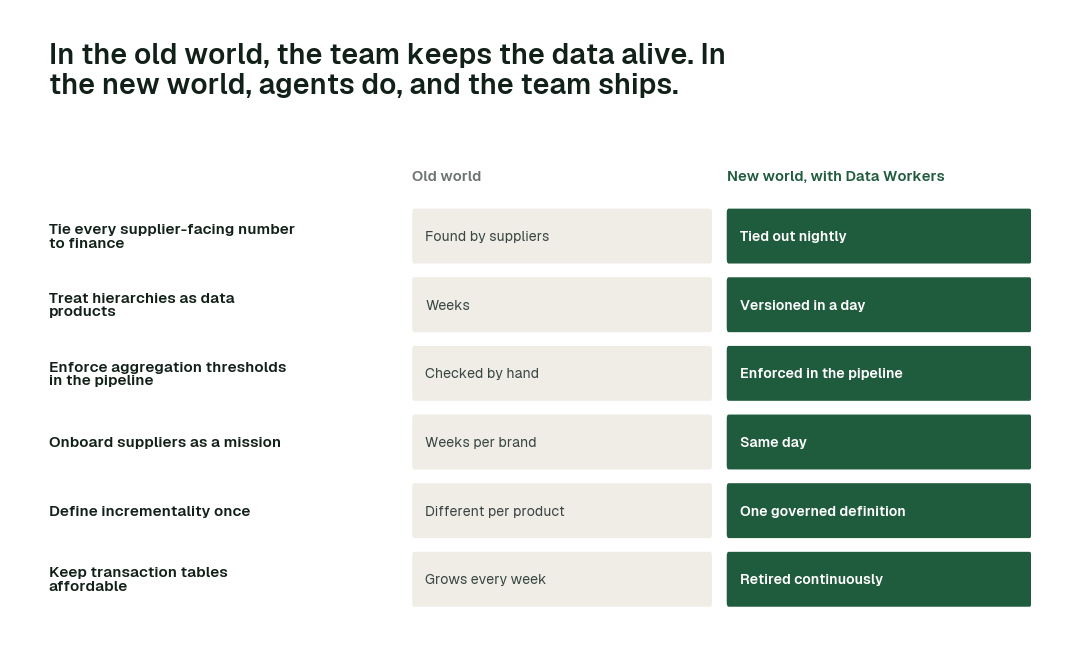
The rest of this report walks through the 6 practices that make that morning possible. At a glance:
The practices, one by one
1. Tie every supplier-facing number to finance
If the portal and the media report disagree, the brand notices first.
The old world. Tie-outs happen when a brand complains.
The new world. Quality Monitoring runs a nightly tie-out across insights, media and finance; Conductor holds a refresh that does not tie.
In practice. A tender-code change is caught before the 6am refresh.
What to measure. Supplier-facing incidents per quarter.
2. Treat hierarchies as data products
Item and store hierarchy changes are the most common cause of broken rollups.
The old world. Reorgs break rollups for weeks.
The new world. Schema Evolution maps hierarchy changes; Pipeline Building versions them and restates history.
In practice. A category reorg is absorbed in a day with comparable history.
What to measure. Days of broken rollups per reorg.
Practices like these compound. Across the routine work they cover, here is the difference in elapsed time:
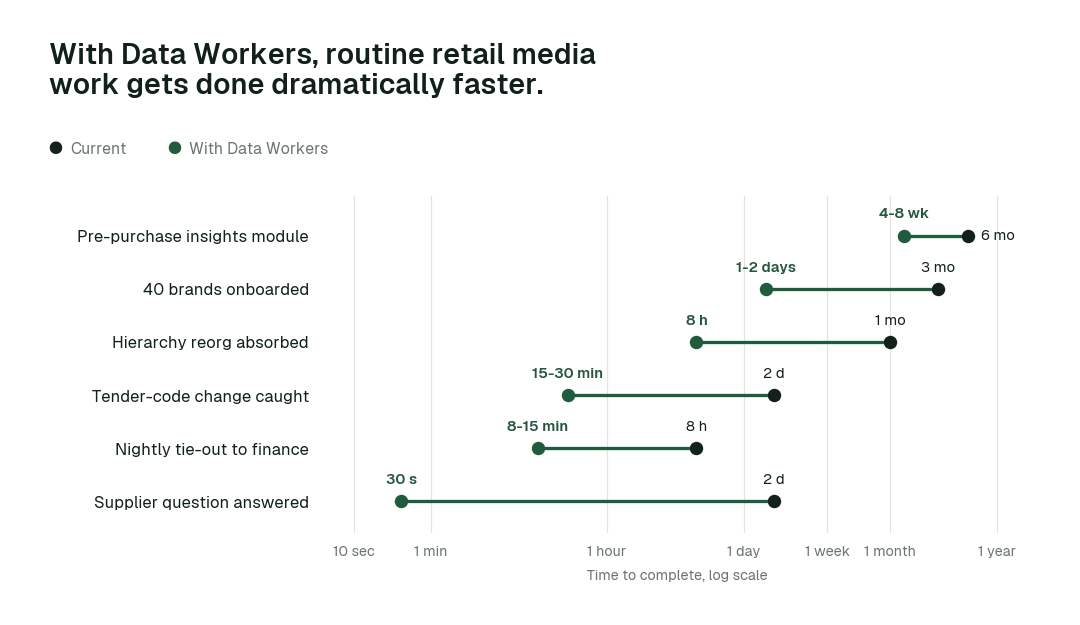
The biggest change is Tender-code change caught: from about 2 days to 15-30 min. Work that waited in queues finishes in minutes or hours, because agents detect, fix and verify in one pass.
3. Enforce aggregation thresholds in the pipeline
Privacy rules belong in the data.
The old world. Checked in reviews.
The new world. Data Security and Access & Governance enforce thresholds and consent on every audience and report.
In practice. A small-store segment below threshold is suppressed automatically.
What to measure. Threshold violations reaching a supplier.
4. Onboard suppliers as a mission
Each new brand needs scoped access, a template and documentation.
The old world. A ticket per brand.
The new world. Autopilot runs onboarding as a mission with receipts.
In practice. Forty brands onboard in a quarter without adding headcount.
What to measure. Days from contract to portal access.
5. Define incrementality once
Lift must mean the same thing in every product you sell.
The old world. Media and insights compute lift differently.
The new world. Context Wizard holds governed definitions used by every product and copilot.
In practice. A brand sees the same incremental sales in two products.
What to measure. Conflicting lift numbers.
That balance, autonomy where work is reversible and a named approver where it matters, shows up clearly by task class:
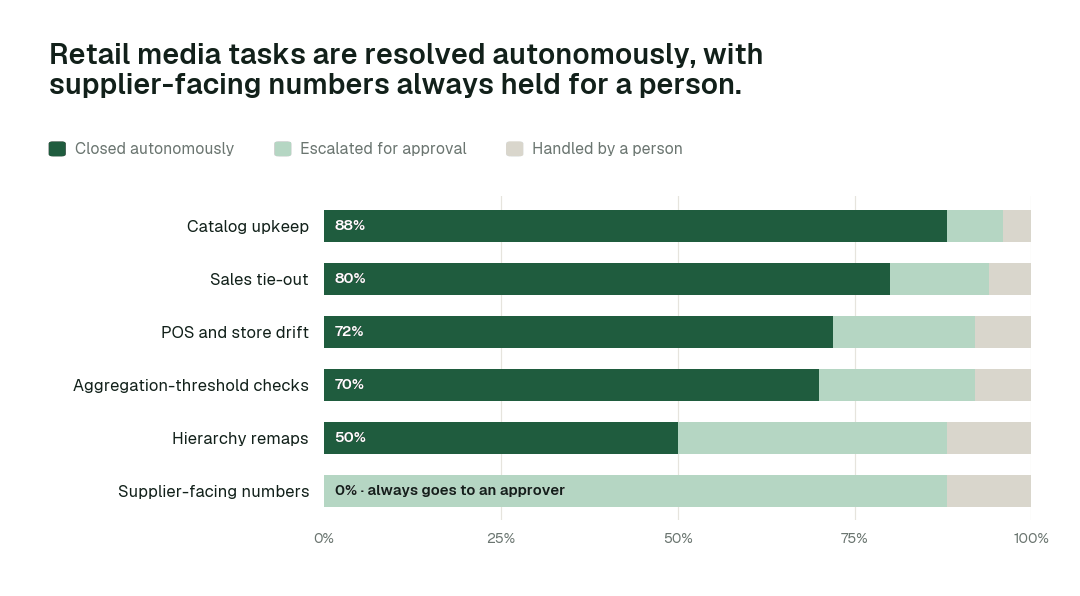
Catalog upkeep closes autonomously 88% of the time. For Supplier-facing numbers, autonomous closure is 0% by design: every change is proposed with a full diff and approved by a named person.
6. Keep transaction tables affordable
Basket data grows every week.
The old world. Copies accumulate.
The new world. Cost Savings & Data Cleanup retires unused copies once lineage proves it safe.
In practice. Storage falls while the product line grows.
What to measure. Cost per million transactions.
Designing the autonomy ladder
Autonomy is set per task class, not per tool. This is where we would set each class for a mature deployment, and why:
| Task class | Closed autonomously | Escalated | Handled by a person | Where we set it | Why |
|---|---|---|---|---|---|
| Catalog upkeep | 88% | 8% | 4% | L4 once the receipts are clean | The work is reversible and repeatable |
| Sales tie-out | 80% | 14% | 6% | L4 once the receipts are clean | The work is reversible and repeatable |
| POS and store drift | 72% | 20% | 8% | L3: acts and keeps a rollback point | Most cases are routine; the rest escalate with evidence |
| Aggregation-threshold checks | 70% | 22% | 8% | L3: acts and keeps a rollback point | Most cases are routine; the rest escalate with evidence |
| Hierarchy remaps | 50% | 38% | 12% | L3 for routine cases, L2 for the rest | Judgment is needed often enough to keep a person close |
| Supplier-facing numbers | 0% | 88% | 12% | L2: always proposed to a named approver | The number carries accountability outside the data team |
The operating model: who owns what
Agents change who does the work, not who is accountable for it:
| Role | Owns | What the agents take off their plate |
|---|---|---|
| Head of Retail Data Products | Standards, autonomy levels per domain and which domain goes next | Assembling status, chasing owners, keeping the catalog current |
| Domain owners and approvers | Supplier-facing numbers and new supplier access | Preparing the diff, blast radius and rollback plan for every proposal |
| Data engineers | Reviewing agent proposals and building new data products | Store sales are tied to finance every night before the supplier portal refreshes; aggregation thresholds are enforced inside the pipeline |
The swarm behind the practices
No single agent delivers these practices. Each one is a hand-off between specialists, coordinated under the autonomy you set per domain.
| Agent | What it does for retail data teams |
|---|---|
| Data Ingestion and Connectors | Land POS, e-commerce, loyalty, inventory and media data on schedule and profile every load |
| Schema Evolution | Maps store-system and item-hierarchy changes into downstream models |
| Pipeline Building | Builds new supplier views, audiences and measurement models with tests |
| Quality Monitoring | Ties sales across the insights portal, retail media reports and finance |
| Data Access & Governance | Onboards suppliers with scoped access and clean-room templates under your policies |
| Data Security | Keeps shopper PII classified and enforces aggregation thresholds |
| Cost Savings & Data Cleanup | Keeps petabyte-scale transaction tables affordable |
Context Wizard holds governed definitions of a household, a sale, an incremental sale and a lift. Conductor verifies supplier-facing numbers before they publish. Spellbook gives every product and dataset a living page.
What disappears
The clearest sign the practices are working is what stops happening:
- •Suppliers finding data errors first.
- •Weeks of broken rollups after reorgs.
- •Per-brand onboarding tickets.
- •Manual privacy-threshold reviews.
- •Conflicting lift numbers across products.
- •Unbounded transaction-table cost.
The magic is not any single agent. It is that the back office simply keeps running. Bad data is caught where it enters, not where it is read. Every new table gets quality rules and documentation without anyone writing them. Access follows policy instead of a queue. Fixes are rerun, verified and explained before anyone opens a dashboard. Cost is cleaned up every week instead of every budget cycle. And every one of those actions leaves a signed receipt, so the team can see exactly what happened and roll anything back. For the people on the team, the experience is quieter mornings, fewer tickets and more time for the products the business asked for.
A product manager's scorecard
If you own this data as a product, these are the numbers to bring to every quarterly review:
- •Supplier-facing incidents per quarter
- •Days from contract to portal access
- •Nights the tie-out passes
- •Threshold violations
- •Share of upkeep autonomous
- •Revenue per data product shipped
The climb: from assisted to autonomous to agentic
Our thesis is that the data platform climbs the way analytics did, in stages, and that the hard part of data work was never knowing what to do but doing it. For retail media and transaction data teams, the climb looks like this:
- •Assisted. Agents work alongside your team. They read the whole stack, show what needs doing and propose every fix with a receipt; supplier-facing numbers and new supplier access always go to a named approver.
- •Autonomous, under your governance. Routine work runs on its own: store sales are tied to finance every night before the supplier portal refreshes, aggregation thresholds are enforced inside the pipeline, and brand onboarding runs as a batch mission with access, templates and documentation. Your team governs the agents instead of doing the upkeep.
- •The agentic enterprise. A retail data business that onboards brands as fast as sales signs them and never shows a supplier a false dip. People set direction, and the platform carries it out.
You choose the altitude, every step is visible and reversible, and the pilot below is the first rung.
The pilot: how retail media and transaction data teams start
The pilot is how your team proves the value on its own data before committing.
- •What we connect. POS and e-commerce platforms; loyalty; Snowflake, BigQuery or Databricks; dbt; clean rooms; supplier portals, over MCP, inside your infrastructure. Nothing migrates.
- •Scope. Nightly tie-out and supplier onboarding at L2.
- •First week. Agents run at L1 across the scoped domain. They map every pipeline, definition and lineage path and show the fixes they would have made, with receipts, so your team sees the value before anything changes.
- •By week two. Store sales are tied to finance every night before the supplier portal refreshes and aggregation thresholds are enforced inside the pipeline start running on reversible work. Supplier-facing numbers and new supplier access stay at L2 with a named approver.
- •At day 30. We review the impact metrics against your baseline:
- •Supplier question answered: from about 2 days to seconds
- •Tender-code change caught: from about 2 days to 15-30 min
- •Hierarchy reorg absorbed: from about a month to hours
- •the share of catalog upkeep closed autonomously, targeting 88% as the deployment matures
- •What you decide. Whether to expand to the next domain. The pilot fee is credited in full against the first year.
- •Cost. Start with a pilot ($7,500 one-time, credited in full against the first year). Scale is from $1,000 a month and Enterprise from $3,000 a month, billed annually, with unlimited seats, no usage meter and no markup on model spend. See pricing.
The pilot is the start of a longer curve:
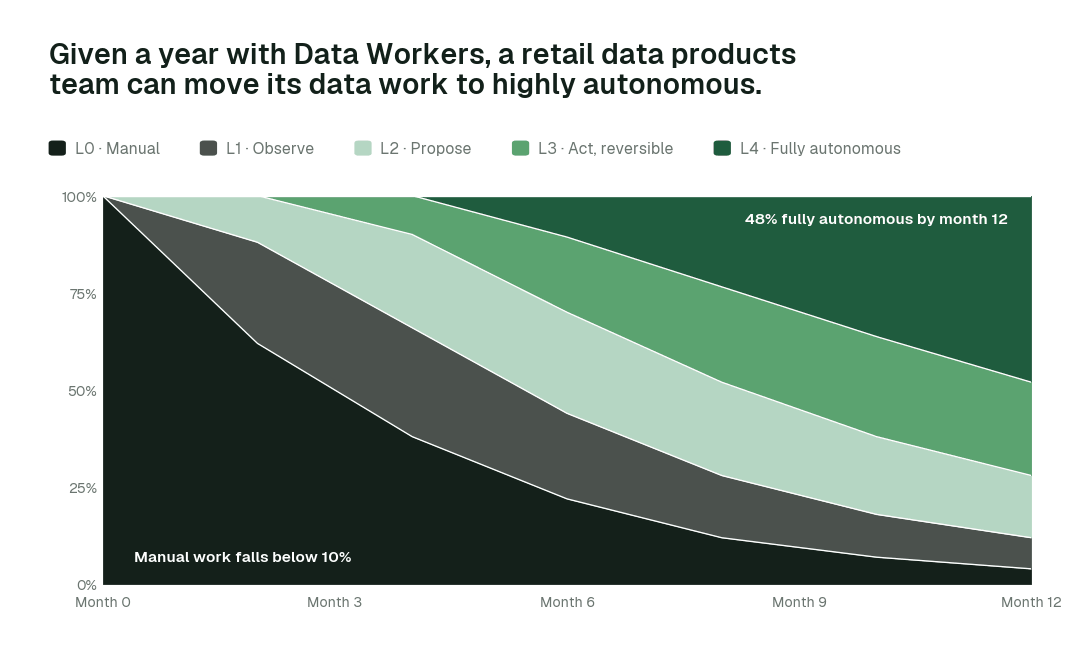
By month 12, more than 48% of agent actions run fully autonomously and manual work falls below 10%, while supplier-facing numbers stay with a named approver.
Read the full playbook: Retail media, insights and supplier data teams