Best practices for agentic provider data management: a field guide for provider data teams
How provider data teams move their data back office to agents, practice by practice: the state of the space, the old world and the new, what the agents do step by step, how to set autonomy, who owns what, and how to start.
Provider data is the quiet dependency behind every claim, directory listing and network decision a health plan makes.
Validating, reconciling and distributing it is repeatable work that agents should run continuously.
The state of the space
The team that owns the provider data lifecycle at a health plan: ingestion from rosters and CAQH, reconciliation across sources, credentialing workflows, the path from contract signature to claim-ready configuration, directory accuracy and distribution to claims, member and regulatory systems. It sits between Network Management, Credentialing, Contracting, Provider Servicing and Claims.
Provider data touches everything a health plan does: who members can see, which claims pay, what the directory says and what regulators audit. It arrives as rosters, spreadsheets and portal updates from thousands of groups, and every error becomes an incorrect denial, a ghost listing or a configuration defect. Agents can reconcile, validate and distribute provider data continuously, so contracts become claim-ready faster and directories stay right.
The old world
A group sends its roster in a new layout; 1,200 updates wait three weeks; new providers' claims deny in the meantime.
It is rarely one failure. Three patterns repeat:
- •A roster that changed format. A large group sends its quarterly roster in a new layout; 1,200 updates wait for an analyst.
- •Contract signed, claims denied. A new group's claims deny for three weeks after signature because configuration lags credentialing.
- •Directory audit readiness. A regulator samples the directory and finds stale addresses.
The new world
The roster was mapped and validated in an hour, invalid records flagged, and clean changes approved and live the same night.
Here is that new world as a chain of hand-offs between agents:
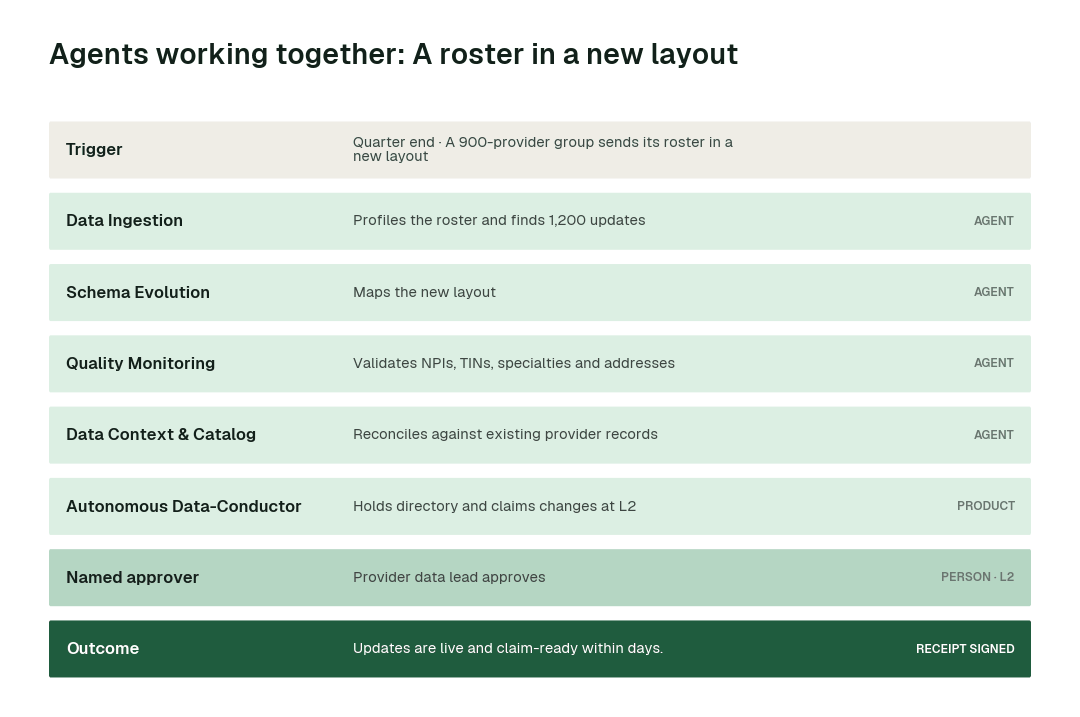
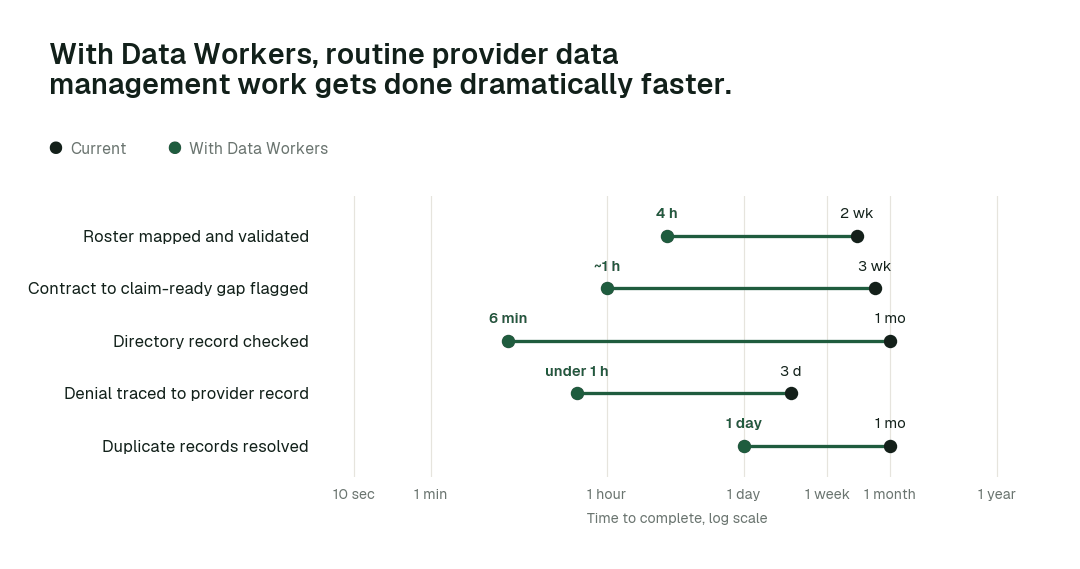
These are the impact metrics we move:
- •Directory record checked: from about a month to minutes
- •Contract to claim-ready gap flagged: from about 3 weeks to ~1 h
- •Denial traced to provider record: from about 3 days to under 1 h
The rest of this report walks through the 5 practices that make that possible. At a glance:
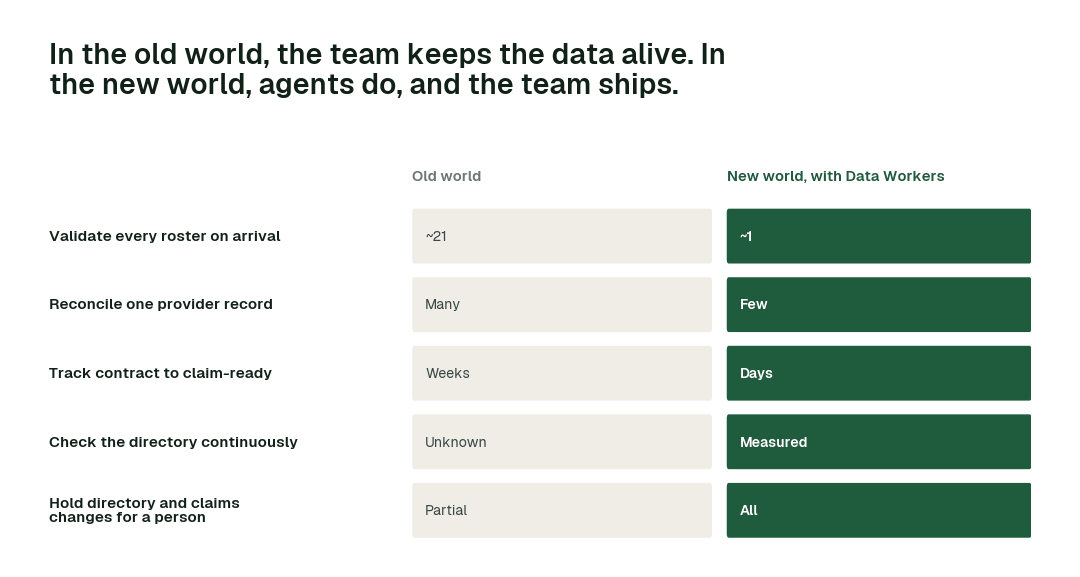
The practices, one by one
1. Validate every roster on arrival
Errors are cheapest at intake.
Why it is harder than it looks. Rosters arrive in thousands of variants.
The old world. Analysts map rosters by hand.
The new world. Ingestion and Quality Monitoring validate NPIs, TINs and specialties.
What the agents do, step by step:
- 1.The Data Ingestion agent calls
get_connector_statusand profiles each roster.
- 1.The Schema Evolution agent calls
generate_migrationand maps the layout.
- 1.The Quality Monitoring agent calls
run_quality_checkand validates NPIs and TINs.
In practice. 1,200 updates processed in a morning.
What to measure. Days from roster to live.
2. Reconcile one provider record
Duplicates cause denials and directory errors.
Why it is harder than it looks. The same provider exists in several systems.
The old world. Three versions of a provider.
The new world. Context Wizard governs the record; duplicates are flagged.
What the agents do, step by step:
- 1.The Data Context & Catalog agent calls
define_business_ruleand governs the provider record.
- 1.The Quality Monitoring agent calls
get_anomaliesand flags duplicates.
- 1.The Autonomous Data-Conductor calls
request_governance_reviewand routes merges.
In practice. One provider, one record.
What to measure. Duplicate provider records.
Practices like these compound. Across the routine work they cover:
3. Track contract to claim-ready
Delays cause incorrect denials.
Why it is harder than it looks. Handoffs span five teams.
The old world. Handoffs by email.
The new world. Agents track every step and flag gaps.
What the agents do, step by step:
- 1.The Autonomous Data-Conductor calls
verify_dataand tracks each step.
- 1.The Incident Debugging agent calls
get_root_causeand traces denials.
- 1.The Data Access & Governance agent calls
request_governance_reviewand routes gaps.
In practice. Configuration lands before the first claim.
What to measure. Days to claim-ready.
4. Check the directory continuously
Audits find stale listings.
Why it is harder than it looks. Directories change faster than audits.
The old world. Annual reviews.
The new world. Quality Monitoring compares listings to claims and attestations.
What the agents do, step by step:
- 1.The Quality Monitoring agent calls
run_quality_checkand compares listings to claims.
- 1.The Quality Monitoring agent calls
get_anomaliesand flags stale listings.
- 1.The Data Context & Catalog agent calls
generate_documentationand records attestations.
In practice. Stale listings flagged weekly.
What to measure. Directory accuracy.
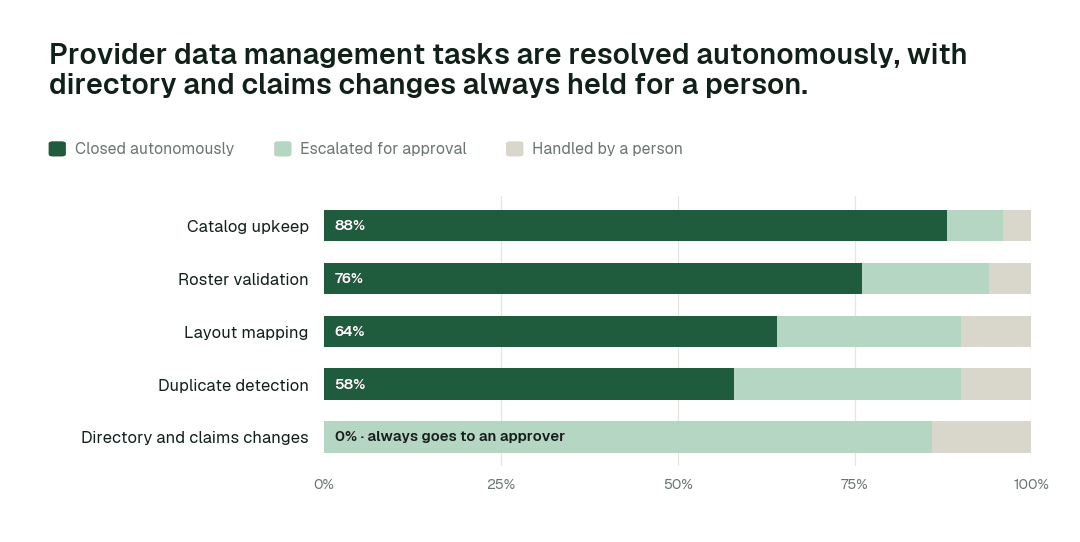
Autonomy where work is reversible, a named approver where it matters:
5. Hold directory and claims changes for a person
They affect members and payment.
Why it is harder than it looks. Members and payment depend on these changes.
The old world. Mixed.
The new world. L2 approvals.
What the agents do, step by step:
- 1.The Data Context & Catalog agent calls
blast_radius_analysisand shows downstream impact.
- 1.The Autonomous Data-Conductor calls
request_governance_reviewand holds at L2.
- 1.The Data Access & Governance agent calls
generate_audit_reportand records approval.
In practice. Every change approved.
What to measure. Changes with approver.
Designing the autonomy ladder
Autonomy is set per task class, not per tool. This is where we would set each class for a mature deployment, and why:
| Task class | Closed autonomously | Escalated | Handled by a person | Where we set it | Why |
|---|---|---|---|---|---|
| Catalog upkeep | 88% | 8% | 4% | L4 once the receipts are clean | The work is reversible and repeatable |
| Roster validation | 76% | 18% | 6% | L3: acts and keeps a rollback point | Most cases are routine; the rest escalate with evidence |
| Layout mapping | 64% | 26% | 10% | L3: acts and keeps a rollback point | Most cases are routine; the rest escalate with evidence |
| Duplicate detection | 58% | 32% | 10% | L3: acts and keeps a rollback point | Most cases are routine; the rest escalate with evidence |
| Directory and claims changes | 0% | 86% | 14% | L2: always proposed to a named approver | The number carries accountability outside the data team |
The operating model: who owns what
Agents change who does the work, not who is accountable for it:
| Role | Owns | What the agents take off their plate |
|---|---|---|
| Director of Provider Data Management | Standards, autonomy levels per domain and which domain goes next | Assembling status, chasing owners, keeping the catalog current |
| Domain owners and approvers | Directory changes and claims configuration | Preparing the diff, blast radius and rollback plan for every proposal |
| Data engineers | Reviewing agent proposals and building new data products | Every roster is validated on arrival; contract-to-claim-ready steps are tracked end to end |
The swarm behind the practices
| Agent | What it does for you | Tools it calls |
|---|---|---|
| Data Ingestion | Profiles rosters, CAQH and portal updates on arrival | get_connector_status, trigger_airflow_dag, register_kafka_schema |
| Schema Evolution | Maps new roster layouts | detect_schema_change, validate_schema_compatibility, generate_migration, rollback_migration |
| Quality Monitoring | NPI, TIN, specialty and address validation; directory accuracy checks | set_sla, run_quality_check, get_anomalies, create_quality_tests_for_pipeline |
| Incident Debugging | Traces denials to the provider record behind them | diagnose_incident, get_root_cause, prepare_backfill, execute_backfill |
| Data Context & Catalog | Governed provider, location and group definitions with lineage | trace_cross_platform_lineage, blast_radius_analysis, define_business_rule, generate_documentation |
| Data Access & Governance | Access and change control for provider records | provision_access, check_policy, request_governance_review, generate_audit_report |
Data Context Wizard keeps one governed graph of definitions, lineage and owners that every agent and person answers from. Autonomous Data-Conductor runs each job from detection to a verified result. Spellbook Data Catalog is where your team approves, audits and rolls back, and asks questions in plain English.
What disappears
- •Three-week roster backlogs.
- •Incorrect denials from lagging configuration.
- •Duplicate provider records.
- •Directory audit surprises.
- •Email handoffs between teams.
The magic is not any single agent. It is that the back office keeps running: bad data is caught where it enters, every new table gets quality rules and documentation without anyone writing them, access follows policy, fixes are verified before anyone opens a dashboard, and every action leaves a signed receipt.
A product manager's scorecard
| Metric | How to read it |
|---|---|
| Days from roster to live | Baseline it in the first week of the pilot; review it monthly. |
| Incorrect denials for credentialed providers | Baseline it in the first week of the pilot; review it monthly. |
| Duplicate provider records | Baseline it in the first week of the pilot; review it monthly. |
| Directory accuracy | Baseline it in the first week of the pilot; review it monthly. |
| Changes with approver | Baseline it in the first week of the pilot; review it monthly. |
Where this goes next
Health plans will run provider data as a continuously validated platform: rosters processed the day they arrive, directories audited weekly by agents and contracts claim-ready on signature.
The climb: from assisted to autonomous to agentic
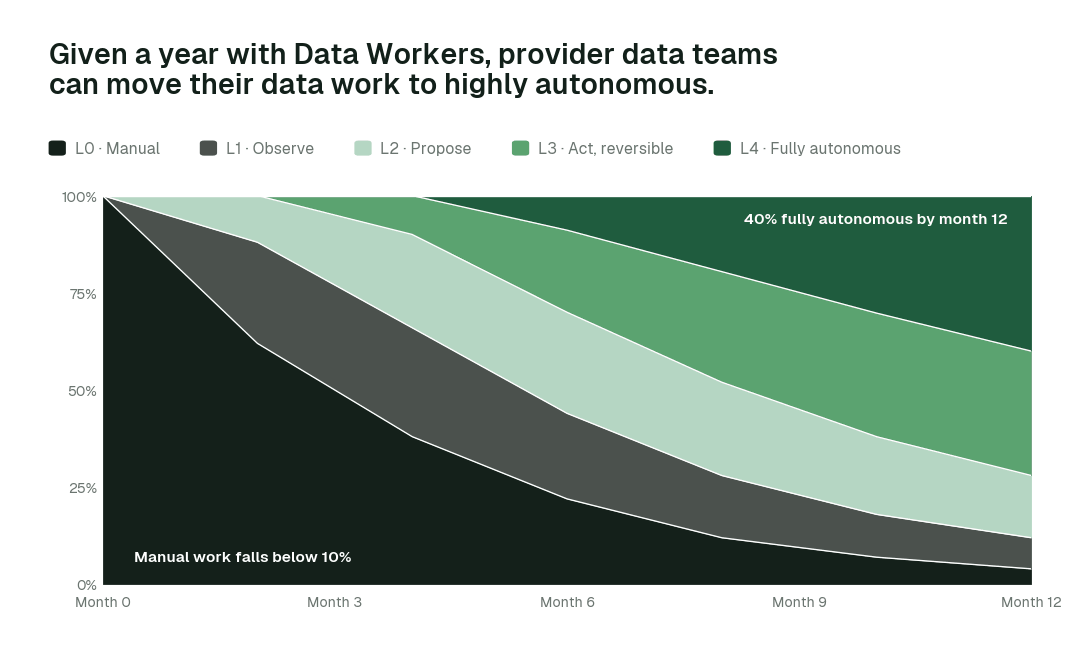
Our thesis is that the data platform climbs the way analytics did, in stages, and that the hard part of data work was never knowing what to do but doing it. For provider data teams, the climb looks like this:
- •Assisted. Agents work alongside your team. They read the whole stack, show what needs doing and propose every fix with a receipt; directory changes and claims configuration always go to a named approver.
- •Autonomous, under your governance. Routine work runs on its own: every roster is validated on arrival, contract-to-claim-ready steps are tracked end to end, and directory listings are checked against recent claims and attestations. Your team governs the agents instead of doing the upkeep.
- •The agentic enterprise. Health plans will run provider data as a continuously validated platform: rosters processed the day they arrive, directories audited weekly by agents and contracts claim-ready on signature.
You choose the altitude, every step is visible and reversible, and the pilot below is the first rung.
The pilot: how provider data teams start
The pilot is how your team proves the value on its own data before committing.
- •What we connect. Provider data platforms and MDM; CAQH and roster intake; Snowflake or Databricks; claims systems such as Facets or QNXT; directory platforms; dbt, over MCP, inside your infrastructure. Nothing migrates.
- •Scope. Roster validation and contract-to-claim-ready tracking for one market at L2.
- •First week. Agents run at L1 across the scoped domain. They map every pipeline, definition and lineage path and show the fixes they would have made, with receipts, so your team sees the value before anything changes.
- •By week two. Every roster is validated on arrival and contract-to-claim-ready steps are tracked end to end start running on reversible work. Directory changes and claims configuration stay at L2 with a named approver.
- •At day 30. We review the impact metrics against your baseline:
- Directory record checked: from about a month to minutes
- Contract to claim-ready gap flagged: from about 3 weeks to ~1 h
- Denial traced to provider record: from about 3 days to under 1 h
- the share of catalog upkeep closed autonomously, targeting 88% as the deployment matures
- •What you decide. Whether to expand to the next domain. The pilot fee is credited in full against the first year.
- •Cost. Start with a pilot ($7,500 one-time, credited in full against the first year). Scale is from $1,000 a month and Enterprise from $3,000 a month, billed annually, with unlimited seats, no usage meter and no markup on model spend. See pricing.
The pilot is the start of a longer curve:
Read the full playbook: Data Workers for provider data teams