The agentic data office: standards that enforce themselves in every domain
Standards that enforce themselves in every domain. That is the bar for chief data offices once agents run the data back office, and it is reachable with the estate you already have. Here is how it works, use case by use case, and what changes compared with today.
Key takeaways
- •Who this is for. Enterprises running a chief data office with business-line domains: banks with data products such as credit risk, party and positions, insurers with a global data office and domain stewards for pricing, underwriting and claims, and asset managers with investment data product owners.
- •The problem today. Quarterly standards checks in spreadsheets, a catalog registered once and never updated, and copilots stalled on conflicting definitions.
- •What changes. Standards are checked in every domain every week, so drift is fixed when it starts, not at the quarterly review. The catalog updates as agents change pipelines, so owners, lineage and definitions stay current.
- •What stays with your people. Changes to regulated, capital or financial-reporting numbers: these carry personal accountability, so a named owner approves.
- •The result. A data office whose standards hold in every domain without stewards chasing owners.
The PRD for agentic chief data offices and data product teams in banks and insurers
This is the requirements document we would write with you for your team. Everything below expands on it.
| Who | CDO offices, data product owners, domain data stewards and enterprise data management teams |
| The job | Standards that enforce themselves in every domain. |
| Environment | Snowflake, Databricks or Teradata; Collibra, Alation or Unity Catalog; dbt; Airflow; BI. |
| Constraints | Changes to regulated, capital or financial-reporting numbers always go to a named approver. Banks and insurers run data under BCBS 239, SOX and model risk guidance. |
| Success is measured by | Access request handled: from about a week to 5 min; Finding a data product: from about 8 hours to 30 s; Standards checked across domains: from about a month to ~1 h; catalog and ownership upkeep closed autonomously 88% of the time. |
| Owned by | A Head of Data Products, with domain owners as named approvers. |
| Pilot scope | Certify the top 50 products as a mission. |
What going fully agentic and autonomous means for chief data offices and data product teams in banks and insurers
- •Put your data pipeline on autopilot. Standards are checked in every domain every week, so drift is fixed when it starts, not at the quarterly review.
- •Run the data back office without the busywork. The work that fills the week today moves to agents: quarterly standards checks in spreadsheets, a catalog registered once and never updated, and copilots stalled on conflicting definitions.
- •Scale data without scaling headcount. The catalog updates as agents change pipelines and routine access requests are handled against firmwide policy, so the data you manage grows without the team having to.
- •Get the plumbing off your plate. A data office whose standards hold in every domain without stewards chasing owners.
Who this is for
Enterprises running a chief data office with business-line domains: banks with data products such as credit risk, party and positions, insurers with a global data office and domain stewards for pricing, underwriting and claims, and asset managers with investment data product owners. Titles include Head of Data Products, Data Product Owner, Data Steward, VP of AI Data Products and Enterprise Data Management lead.
The product you ship
- •Domain data products such as party, positions, policies, claims and exposures, registered in a firmwide catalog.
- •Governed definitions the whole firm uses for exposure, client, premium and loss.
- •Reuse. One data product serves risk, finance, analytics and AI use cases.
- •Evidence that every number executives and boards see can be traced.
Where the week goes
- •Every domain builds differently. The mesh has standards on paper and drift in practice.
- •Catalogs go stale. Data products are registered once and never updated.
- •Stewards spend their week on spreadsheets. Definitions, owners and quality are tracked by hand.
- •Access is a queue. Every request needs a policy check and a person.
- •AI pilots stall. Nobody trusts the definitions enough to let copilots answer.
Add it up and upkeep is most of the team's week. Here is how a typical week splits today, and once agents own the back office:
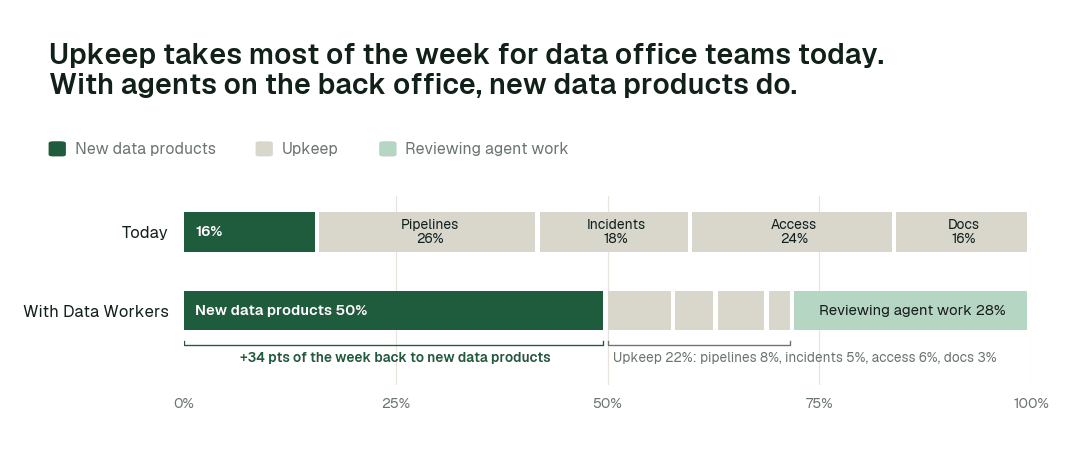
Time spent on new data products moves from 16% of the week to 50%. Most of the rest becomes review: people steer and approve agent work instead of doing it by hand.
Then and now
| Work | Today | With Data Workers |
|---|---|---|
| Domain standards | Written down, checked quarterly | Enforced weekly by agents, gaps shown per domain |
| Firmwide catalog | Registered once, stale after | Kept current as agents work |
| Conflicting definitions | Discovered in executive meetings | Found and reconciled before AI uses them |
| Access requests | Queued per domain | Handled against firmwide policy |
| Legacy EDM retirement | Multi-year program | Waves with parity checks |
| Autonomy per domain | Unknown | Measured on the Autopilot dashboard |
These are the impact metrics we move for chief data offices and data product teams in banks and insurers:
- •Access request handled: from about a week to 5 min
- •Finding a data product: from about 8 hours to 30 s
- •Standards checked across domains: from about a month to ~1 h
Across the routine work in this domain:
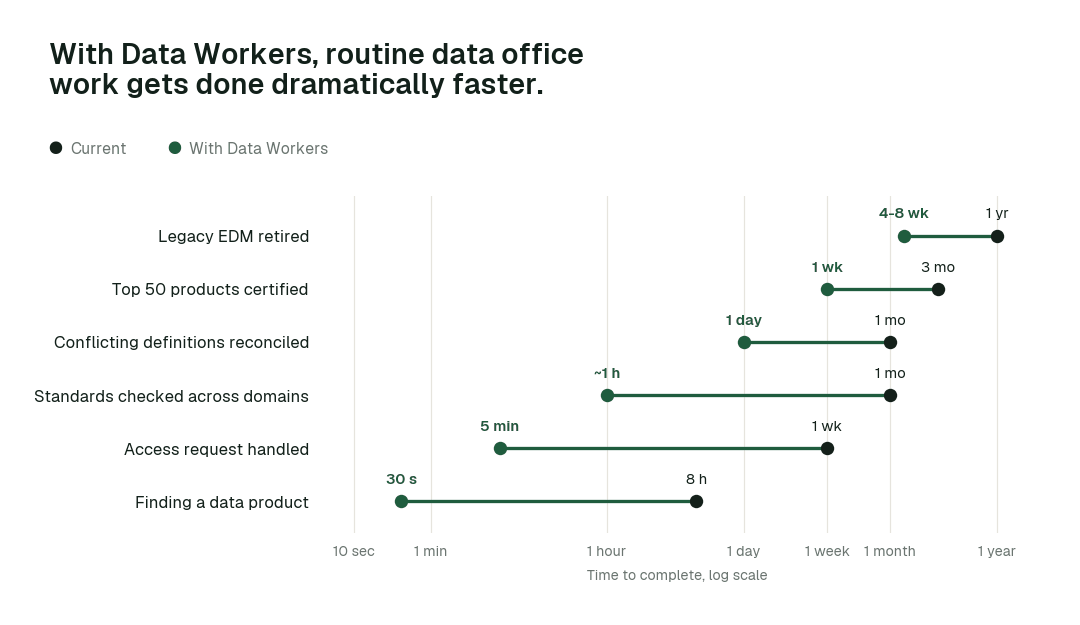
The biggest change is Access request handled: from about a week to 5 min. Work that waited in queues finishes in minutes or hours, because agents detect, fix and verify in one pass.
Use cases, in depth
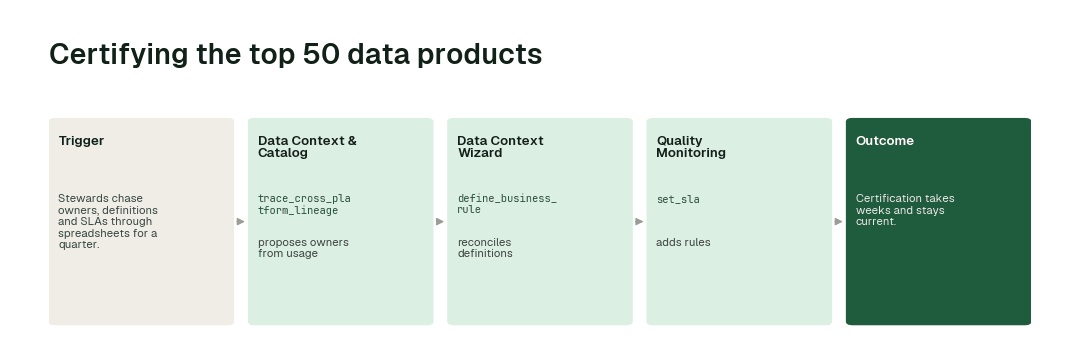
Certifying the top 50 data products
Today. Stewards chase owners, definitions and SLAs through spreadsheets for a quarter.
With Data Workers. Data Context & Catalog proposes owners from usage, Context Wizard reconciles definitions, Quality Monitoring adds rules and the dashboard tracks certification by domain.
What changes. Certification takes weeks and stays current.
Reconciling three definitions of client
Today. Risk, finance and the front office report different client counts.
With Data Workers. Context Wizard maps every definition in use, shows where they diverge and publishes one governed definition after the steward decides.
What changes. Copilots and reports agree.
Retiring legacy reference data
Today. The EDM platform outlives three attempts to retire it.
With Data Workers. Data Migration moves consumers in waves, lineage proves when the last one has moved, and parity checks run every wave.
What changes. The platform is switched off on evidence, not hope.
Agents working together: Making a firmwide standard real
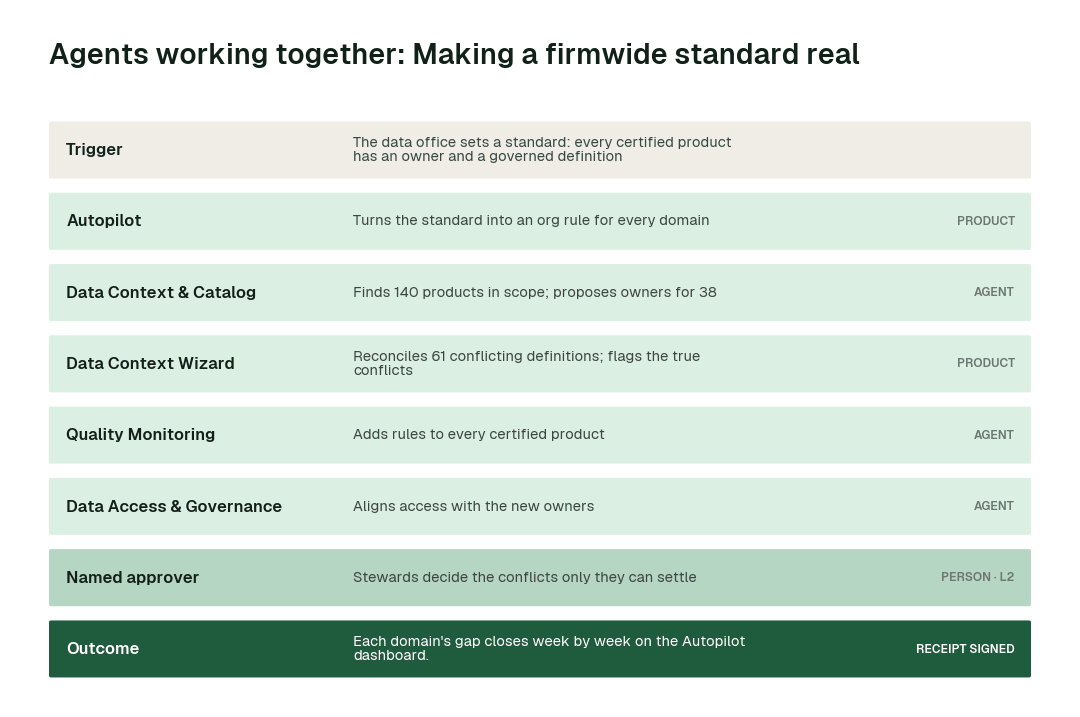
The office sets a standard: every certified data product has an owner and a governed definition. Agents find 140 data products in scope, 38 missing an owner and 61 with conflicting definitions. Context & Catalog proposes owners from commit and query history, Context Wizard reconciles definitions and flags the conflicts that need a steward decision, and the Autopilot dashboard shows each domain's gap closing week by week.
Minute by minute
Illustrative example. The office sets a standard: every certified product has an owner, SLA and governed definition.
| Time | Who | What happens |
|---|---|---|
| Week 1 | Autopilot | Standard set as an org rule |
| Week 1 | Autonomous Data-Conductor | 140 products found; 38 without owners |
| Week 2 | Autonomous Data-Conductor | Owners proposed from usage history |
| Week 2 | Quality Monitoring agent | 61 definition conflicts reconciled; 12 flagged |
| Week 3 | Spellbook Data Catalog | Stewards decide the 12 |
| Week 4 | Autopilot | Gap closing per domain on the dashboard |
The agents on the job
| Agent | What it does for a CDO office | Tools it calls |
|---|---|---|
| Data Context & Catalog | Registers and maintains every data product with owner, SLA, lineage and definitions | trace_cross_platform_lineage, blast_radius_analysis, define_business_rule, generate_documentation |
| Quality Monitoring | Writes and runs quality rules per domain and reports against standards | set_sla, run_quality_check, get_anomalies, create_quality_tests_for_pipeline |
| Data Access & Governance | Applies firmwide policy to every request and logs every grant | provision_access, check_policy, request_governance_review, generate_audit_report |
| Pipeline Building | Builds new domain data products to the firm's standards | generate_pipeline, validate_pipeline, sandbox_test, deploy_pipeline |
| Data Migration | Moves legacy EDM and warehouse workloads in approved waves | generate_migration, validate_migration, verify_data |
| Incident Debugging | Traces a bad number across domains to its source | diagnose_incident, get_root_cause, prepare_backfill, execute_backfill |
Spellbook Data Catalog is where agentic governance happens: agents keep definitions, ownership and policy work current, and the office points the fleet and audits anything. Context Wizard gives copilots and agents governed meaning with provenance. Autopilot turns firmwide rules into org standards every domain is held to automatically.
What goes on autopilot
Once a domain has earned it, this work runs on its own, and each item removes a problem your team deals with today:
- •Standards are checked in every domain every week, so drift is fixed when it starts, not at the quarterly review.
- •The catalog updates as agents change pipelines, so owners, lineage and definitions stay current.
- •Routine access requests are handled against firmwide policy, so domains stop waiting on tickets.
Where your people stay in charge
Agents never get blanket access. Each domain has its own autonomy level, set by you, and it only rises when the receipts show the agents are reliable. Everything starts at L1, observing only; reversible upkeep such as reruns, staging fixes, documentation and cleanup is usually first to run on its own.
- •Changes to regulated, capital or financial-reporting numbers always goes to a named approver: these carry personal accountability, so a named owner approves.
- •Sign-off on filed reports and definition disputes: stewards and control owners decide.
Once a deployment has matured, here is how that ladder plays out across task classes:
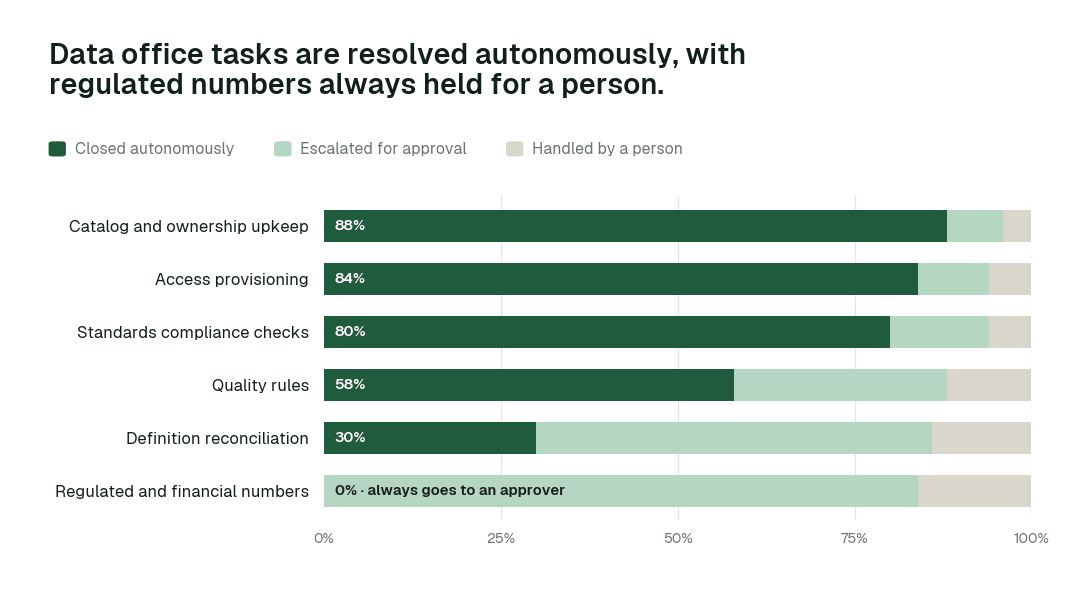
Catalog and ownership upkeep closes autonomously 88% of the time. For Regulated and financial numbers, autonomous closure is 0% by design: every change is proposed with a full diff and approved by a named person.
What happens when an agent is wrong
- •At L2 propose, nothing changes until a named person approves. The proposal shows the full diff, the blast radius and how to roll it back. Unanswered requests expire and escalate.
- •At L3 act, reversibly, every change keeps a rollback point, and Conductor verifies the downstream number after the change. If verification fails, the change is reversed and the domain drops a level.
- •No agent approves or promotes its own work. Autonomy only grows on evidence, per repair class, and repeated errors shrink scope automatically.
- •One org-wide stop halts all autonomous dispatch, and every action lands in a hash-chained audit trail you can export with generate_audit_report.
How it fits your stack
Data Workers connects to what you already run: Snowflake, Databricks or Teradata; Collibra, Alation or Unity Catalog; dbt; Airflow; BI. Each agent is an MCP server, so the same agents work inside Claude Code, Cursor or Codex and in Slack or Teams through Spellbook. Nothing migrates.
- •Runs in your infrastructure with your credentials and your model key. The hosted Autonomous Data-Conductor sees workflow metadata only, never rows.
- •Uses the access you already govern. Agents act under scoped service identities and your existing roles; every grant goes through provision_access and is logged.
- •Proposes changes as diffs in your dbt project, orchestrator and warehouse, with blast radius, tests and a rollback point, and applies them only at the autonomy level you set for that domain.
- •Open-source core. The Apache-2.0 community edition ships 11 agents and 160+ MCP tools, so your engineers can read exactly what the agents call.
Governance and regulation
Banks and insurers run data under BCBS 239, SOX and model risk guidance. Data Workers supplies lineage, documented controls, named approvals and an audit trail; your control functions decide sufficiency.
Data Workers doesn't make you compliant; your controls, people and assessors do. It supplies controls and evidence wherever agents touch data. Not legal advice.
The alternatives chief data offices and data product teams in banks and insurers weigh
Build it yourselves. A strong team can wire a coding agent to MCP servers for the warehouse and dbt. The work is everything around it: routing approvals to the right owner, blast radius, rollback, receipts, and current context about every other system.
Observability, catalogs and point tools. Observability alerts, catalogs document, and quality tools test. Data Workers takes their signals, diagnoses, proposes the fix, verifies it and leaves the receipt.
Platform-native agents. Snowflake made its managed MCP server and Cortex Agents generally available on Nov 4, 2025, and Databricks made Genie One generally available on Jun 16, 2026. They are excellent inside their platform; this work crosses the source systems, orchestrator, warehouse and BI, and Data Workers works across all of them.
In this space specifically. Catalogs record standards; Data Workers enforces them across domains and keeps the catalog current.
The case for your CTO
What this replaces. Quarterly standards checks in spreadsheets, a catalog registered once and never updated, and copilots stalled on conflicting definitions.
What your team gets back. A data office whose standards hold in every domain without stewards chasing owners.
Integration effort. Connecting is configuration, not a migration. The agents attach over MCP to the warehouse, orchestrator, dbt project and source systems you already run, under the roles you already govern, inside your own infrastructure. Your engineers can read every tool the agents call in the open-source core.
Risk and control. Autonomy is set per domain. Everything starts at L1, observing only; reversible work moves up only when the receipts justify it; changes to regulated, capital or financial-reporting numbers stay at L2 with a named approver; and one org-wide stop halts all autonomous work.
Why now. AI programs stall on conflicting definitions.
The first win. Certify the top 50 products as a mission. The pilot below lays out the scope, what you see each week and the cost.
The climb: from assisted to autonomous to agentic
Our thesis is that the data platform climbs the way analytics did, in stages, and that the hard part of data work was never knowing what to do but doing it. For chief data offices and data product teams in banks and insurers, the climb looks like this:
- •Assisted. Agents work alongside your team. They read the whole stack, show what needs doing and propose every fix with a receipt; changes to regulated, capital or financial-reporting numbers always go to a named approver.
- •Autonomous, under your governance. Routine work runs on its own: standards are checked in every domain every week, the catalog updates as agents change pipelines, and routine access requests are handled against firmwide policy. Your team governs the agents instead of doing the upkeep.
- •The agentic enterprise. A data office whose standards hold in every domain without stewards chasing owners. People set direction, and the platform carries it out.
You choose the altitude, every step is visible and reversible, and the pilot below is the first rung.
The pilot: how chief data offices and data product teams in banks and insurers start
The pilot is how your team proves the value on its own data before committing.
- •What we connect. Snowflake, Databricks or Teradata; Collibra, Alation or Unity Catalog; dbt; Airflow; BI, over MCP, inside your infrastructure. Nothing migrates.
- •Scope. Certify the top 50 products as a mission.
- •First week. Agents run at L1 across the scoped domain. They map every pipeline, definition and lineage path and show the fixes they would have made, with receipts, so your team sees the value before anything changes.
- •By week two. Standards are checked in every domain every week and the catalog updates as agents change pipelines start running on reversible work. Changes to regulated, capital or financial-reporting numbers stay at L2 with a named approver.
- •At day 30. We review the impact metrics against your baseline:
- •Access request handled: from about a week to 5 min
- •Finding a data product: from about 8 hours to 30 s
- •Standards checked across domains: from about a month to ~1 h
- •the share of catalog and ownership upkeep closed autonomously, targeting 88% as the deployment matures
- •What you decide. Whether to expand to the next domain. The pilot fee is credited in full against the first year.
- •Cost. Start with a pilot ($7,500 one-time, credited in full against the first year). Scale is from $1,000 a month and Enterprise from $3,000 a month, billed annually, with unlimited seats, no usage meter and no markup on model spend. See pricing.
The pilot is the start of a longer curve:
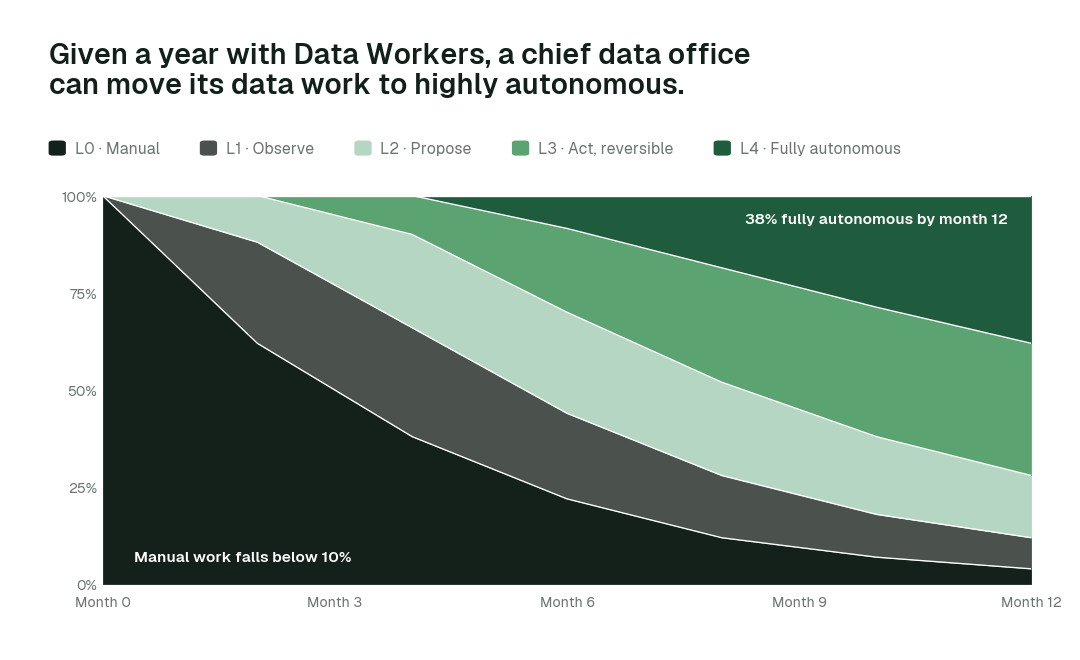
By month 12, more than 38% of agent actions run fully autonomously and manual work falls below 10%, while regulated numbers stay with a named approver.
FAQ
Does it replace Collibra? No; it keeps it current and enforces standards.
Who decides definitions? Stewards; agents propose.
Can it measure autonomy per domain? Yes, on the Autopilot dashboard.
Where do the agents run? In your infrastructure, with your credentials and model key. The hosted Conductor sees workflow metadata only.
Do we have to migrate anything? No. Your warehouse, dbt project, orchestrator, catalog and BI stay where they are.
Sources
- •JPMorgan Chase CDAO: https://www.jpmorganchase.com/careers/explore-opportunities/programs/data-analytics-opportunities
- •Liberty Mutual product management roles: https://searchjobs.libertymutualgroup.com/careers?query=Product+management&domain=libertymutual.com
- •Data Workers pricing: https://dataworkers.io/pricing/
- •Data Workers open-source repository (tool registrations): https://github.com/DataWorkersProject/dataworkers-claw-community
- •Snowflake, managed MCP server and Cortex Agents GA release note (Nov 4, 2025): https://docs.snowflake.com/en/release-notes/2025/other/2025-11-04-cortex-agents-mcp
- •Databricks, Genie One launch (Jun 16, 2026): https://www.databricks.com/company/newsroom/press-releases/databricks-launches-genie-one-all-new-agentic-coworker-every-team