How AI Agents Cut Snowflake Costs by 40% Without Manual Tuning
Autonomous warehouse optimization that works while you sleep
Snowflake cost optimization is the practice of systematically reducing warehouse, storage, and query spend without degrading performance. AI agents now cut Snowflake bills 30-40% by continuously right-sizing warehouses, eliminating zombie tables, and rewriting inefficient queries — work that no human team has time to do consistently.
It is the single highest-leverage initiative most data teams are ignoring. The average enterprise Snowflake bill grew 34% year-over-year in 2025 according to a Synctera analysis, and most teams have no systematic approach to controlling it. They throw credits at warehouses, let zombie tables accumulate, and hope finance does not notice until the quarterly review. The problem is not that optimization is hard — it is that it requires constant, tedious attention that no human wants to give it.
At Data Workers, our Cost Optimization Agent monitors your Snowflake environment continuously — warehouse utilization, query patterns, storage bloat, clustering efficiency — and takes action autonomously. No dashboards to check. No runbooks to follow. No weekend war rooms when the bill spikes.
Why Snowflake Costs Spiral Out of Control
Snowflake's consumption-based pricing is elegant in theory and brutal in practice. Every query, every warehouse spin-up, every byte of storage costs money. The problem is that cost accountability is distributed across every analyst, engineer, and BI tool that touches the platform — and none of them are incentivized to optimize.
- •Over-provisioned warehouses. Teams spin up XL warehouses for development queries that need a Small. A single over-provisioned warehouse running 8 hours a day can waste $50,000-$100,000 per year.
- •Zombie tables and stale data. Tables created for one-off analyses, staging tables that outlived their pipelines, materialized views nobody queries — they accumulate silently. The average Snowflake account has 20-30% storage consumed by data nobody uses.
- •Inefficient queries. Full table scans on multi-terabyte tables, missing clustering keys, redundant CTEs that force recomputation — these patterns multiply costs by 3-5x over well-optimized equivalents.
- •No auto-suspend discipline. Warehouses left running during off-hours, auto-suspend set to 10 minutes instead of 60 seconds, auto-resume triggering on health checks — the waste adds up fast.
- •Materialized view sprawl. Teams create materialized views to speed up dashboards, then forget about them. Each one consumes storage and compute for maintenance, whether anyone queries it or not.
The root cause is simple: Snowflake gives you granular usage data, but turning that data into action requires dedicated engineering time that most teams cannot justify. So costs drift upward, quarter after quarter, until someone in finance demands a 30% cut and the team scrambles.
How AI Agents Approach Snowflake Cost Optimization
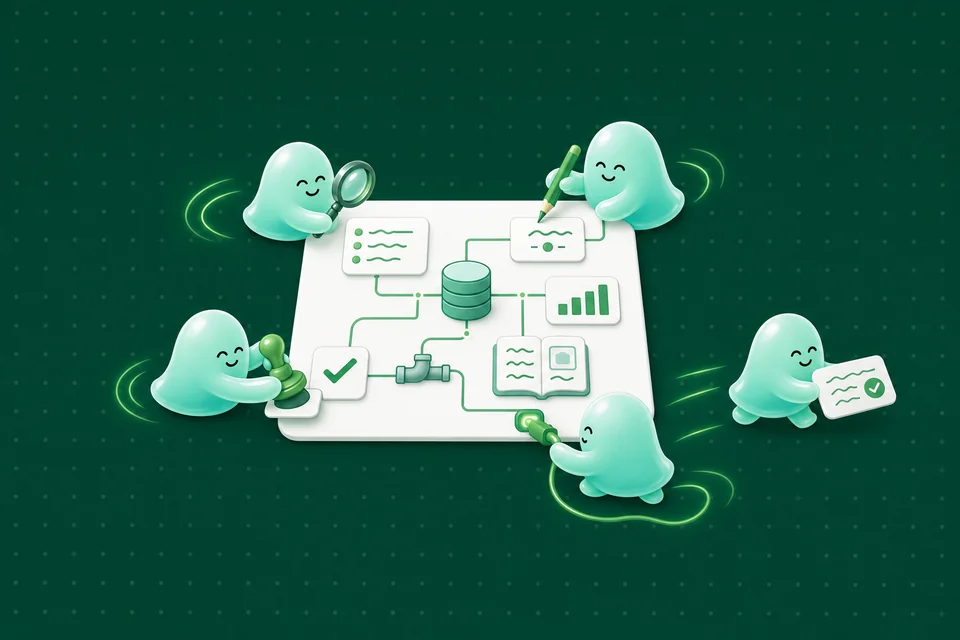
The Data Workers Cost Optimization Agent treats your Snowflake environment as a continuously optimizable system. It does not generate reports for humans to act on — it identifies waste and eliminates it directly, with configurable guardrails and approval workflows for high-impact changes.
Here is what the agent does across five optimization surfaces:
Warehouse Auto-Sizing: Right-Size Every Workload Automatically
The agent analyzes query execution patterns per warehouse — peak concurrency, average queue time, spill-to-disk frequency, credit consumption per query — and determines the optimal warehouse size for each workload profile. A warehouse running XL for queries that complete in the same time on Medium gets automatically resized.
This is not a one-time recommendation. The agent adjusts warehouse sizes dynamically based on workload changes. Monday morning dashboard refreshes might need a Large. Tuesday afternoon ad-hoc queries might only need a Small. The agent handles the transitions automatically, including auto-suspend thresholds tuned per warehouse based on actual usage patterns.
Typical savings from warehouse auto-sizing alone: 15-25% of total compute costs.
Zombie Table Detection: Eliminate Storage You Are Paying For But Not Using
The agent scans your entire Snowflake account for tables, views, and materialized views that have not been queried in a configurable period — 30, 60, or 90 days. It cross-references query history, downstream dependencies, and pipeline schedules to distinguish between genuinely unused objects and tables that are only queried monthly or quarterly.
For confirmed zombie tables, the agent can archive to external storage, drop with a configurable grace period, or flag for human review depending on your policy. One enterprise customer discovered 4.2 TB of zombie tables — $14,000 per month in storage costs for data nobody accessed in over six months.
Query Optimization: Rewrite Expensive Patterns Automatically
The agent identifies the top cost-driving queries by credit consumption and analyzes them for optimization opportunities: missing clustering keys that cause full partition scans, SELECT * patterns that pull unnecessary columns, redundant subqueries that could be refactored, and joins that could benefit from query result caching.
For dbt projects, the agent can submit pull requests with optimized SQL. For ad-hoc queries, it surfaces recommendations to the query authors through Slack or email. For scheduled queries, it can apply optimizations directly with approval workflows.
Clustering and Materialized View Management
Clustering keys are the single most impactful performance optimization in Snowflake, but choosing the right keys requires analyzing actual query filter patterns across hundreds of tables. The agent does this automatically — it examines WHERE clause patterns, JOIN conditions, and partition pruning efficiency to recommend and apply optimal clustering keys.
For materialized views, the agent tracks the ratio of maintenance cost to query benefit. A materialized view that costs $500/month in maintenance compute but only serves 3 queries per week is a candidate for replacement with a scheduled table refresh or simple query optimization. The agent identifies these imbalances and proposes alternatives.
Manual vs AI-Agent Snowflake Cost Optimization
Here is how traditional manual optimization compares to an AI-agent approach:
| Optimization Area | Manual Approach | AI Agent Approach |
|---|---|---|
| Warehouse sizing | Quarterly review of utilization dashboards; manual resize requests | Continuous monitoring with automatic right-sizing based on workload patterns |
| Zombie table cleanup | Annual or ad-hoc audit; engineers manually review tables | Continuous scanning with dependency-aware archival and configurable grace periods |
| Query optimization | Top-N expensive query review; manual rewrite | Automated pattern detection across all queries; PR-based fixes for dbt projects |
| Clustering key selection | Manual analysis of query patterns per table | Automated WHERE clause analysis across entire warehouse; applied with approval gates |
| Materialized view ROI | Rarely tracked; views accumulate indefinitely | Continuous cost-benefit analysis; automatic recommendations when ROI turns negative |
| Time investment | 40-80 hours per quarter for a dedicated engineer | Under 2 hours per quarter for review and approvals |
| Typical savings | 10-20% with consistent effort | 30-40% with continuous autonomous optimization |
| Responsiveness | Quarterly optimization cycles | Real-time detection and response within minutes |
Real-World Impact: What 30-40% Cost Reduction Looks Like
For a company spending $500,000 per year on Snowflake — which is on the low end for mid-market enterprises — a 30-40% reduction means $150,000-$200,000 in annual savings. That is a senior data engineer's fully-loaded salary redirected from Snowflake credits to actual engineering work.
The savings compound over time. As your data volume grows, an unoptimized Snowflake environment scales costs linearly (or worse). An AI-optimized environment scales costs sub-linearly because the agent continuously prunes waste, right-sizes resources, and optimizes queries as new patterns emerge.
Data Workers customers report achieving a 30-40% warehouse cost reduction within the first 60 days. The Cost Optimization Agent is part of a coordinated swarm of 15 specialized AI agents that cover the full data engineering lifecycle — from pipeline building to incident debugging to governance and beyond.
Getting Started with AI-Driven Snowflake Optimization
The Cost Optimization Agent connects to your Snowflake account via MCP (Model Context Protocol), the open standard for AI tool integration. It requires read access to ACCOUNT_USAGE views and configurable write permissions for the optimization actions you want to automate. Setup takes under 30 minutes.
- •Week 1: The agent audits your environment and produces a cost baseline with prioritized optimization opportunities.
- •Week 2-4: Automated optimizations begin rolling out — warehouse resizing, zombie cleanup, clustering improvements — with all changes logged and reversible.
- •Month 2+: Continuous optimization maintains savings as your environment evolves. New tables, new queries, and new warehouses are optimized automatically.
Read the full technical documentation at Docs or explore the open-source agent architecture on GitHub.
Stop paying for Snowflake waste that an AI agent can eliminate in days. Book a Demo to see the Cost Optimization Agent running against a real Snowflake environment — and get a preliminary cost savings estimate for your account.
Go from data platform to
agentic platform.
With autonomous AI agents working across your entire data stack — MCP-native, open-source, deployed in minutes.
Book a Demo →Related Resources
- BigQuery Cost Optimization: How AI Agents Right-Size Slots and Cut Waste — BigQuery cost optimization requires understanding on-demand vs capacity pricing, slot right-sizin…
- Claude Code + Cost Optimization Agent: Cut Your Snowflake Bill from the Terminal — Ask 'which tables are wasting money?' in Claude Code. The Cost Optimization Agent scans your ware…
- Mcp For Cost Optimization Agents — Mcp For Cost Optimization Agents
- Cost Agent Snowflake Optimization — Cost Agent Snowflake Optimization
- AI-Powered Data Warehouse Cost Optimization: Slash Snowflake/BigQuery Bills by 40% — AI-powered data warehouse cost optimization uses autonomous agents to continuously monitor and op…