A playbook for data leaders at equipment makers
If you are a data leader at an equipment maker, this is your playbook. It covers what your team ships, where its week goes today, the use cases agents take over first, the autonomy you can safely grant in each domain, and what to show leadership after the first quarter.
Key takeaways
- •Who this is for. Data leaders and teams at equipment makers and industrial companies.
- •The problem today. Most of the data team's week goes to converter backlogs and manual sharing.
- •What changes. Specialised agents take that work over across the systems you already run: they catch bad data where it enters, fix it where it lives and verify the number before anyone reads it.
- •What stays with your people. Anything regulated or customer-facing waits for a named approver with the full diff, blast radius and rollback plan in front of them.
- •The result. Data teams that spend their time on machine data services that work on day one.
The PRD for agentic data in agriculture and industrial
This is the requirements document we would write with you. Everything below expands on it.
| Who | Data leaders and teams at equipment makers and industrial companies. |
| The job | Machine data that becomes products. |
| Environment | IoT ingestion; cloud lakes on AWS or Azure; Databricks or Snowflake; partner APIs; operations center applications, and the other platforms your teams run. |
| Constraints | Regulated and customer-facing numbers always go to a named approver; agents run in your infrastructure under the roles you already govern. |
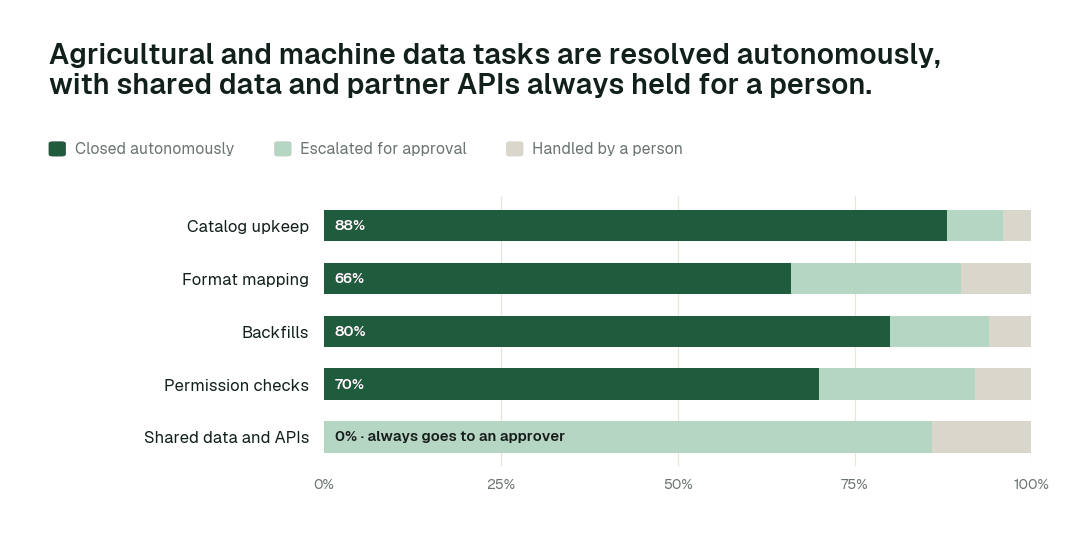
| Success is measured by | Sharing permission applied: from about a week to 5 min; API change checked: from about 3 days to 15-20 min; New model format mapped: from about a month to hours; catalog upkeep closed autonomously 88% of the time. |
| Owned by | The head of data or CDO, with domain owners as named approvers. |
| Pilot scope | Format mapping on one product line. |
What going fully agentic and autonomous means in agriculture and industrial
- •Put your data pipelines on autopilot. Agents catch bad data where it enters, fix it where it lives and verify the number before anyone reads it.
- •Run the data back office without the busywork. The week that goes to converter backlogs and manual sharing moves to agents.
- •Scale data without scaling headcount. New sources, partners and data products are onboarded as missions, not projects.
- •Get the plumbing off your plate. Data teams spend their time on machine data services that work on day one.
The shift
Tractors, combines and industrial machines stream telemetry and agronomic data to operations centers that customers and partners use daily. New model years bring new formats, and customers control who sees their data.
Our view: agents should map machine data, enforce sharing permissions and protect partner APIs, so product teams build services instead of converters.
A day on a agriculture and industrial data team today
A new combine model uploads a new yield format at harvest and maps wait for a converter release. A partner app breaks after an internal API change. Sharing permissions are applied by hand.
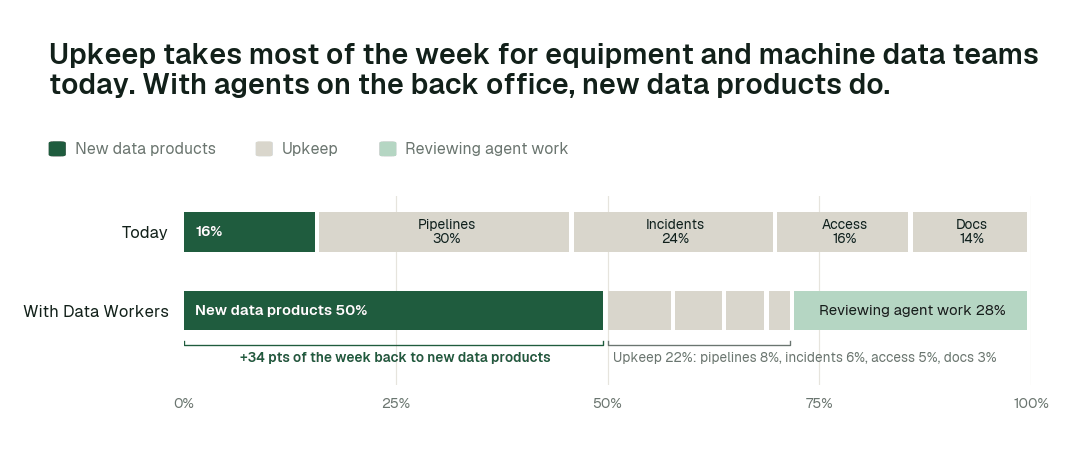
That week is typical, not exceptional. Here is where the time goes, today and with agents on the back office:
Then and now
| Work | Today | With Data Workers |
|---|---|---|
| New model formats | Converters | Mapped on first upload |
| Sharing permissions | Manual | Enforced |
| Partner APIs | Break | Versioned |
| Late field data | Gaps | Backfilled |
| Maintenance models | Drift silently | Monitored |
These are the impact metrics we move:
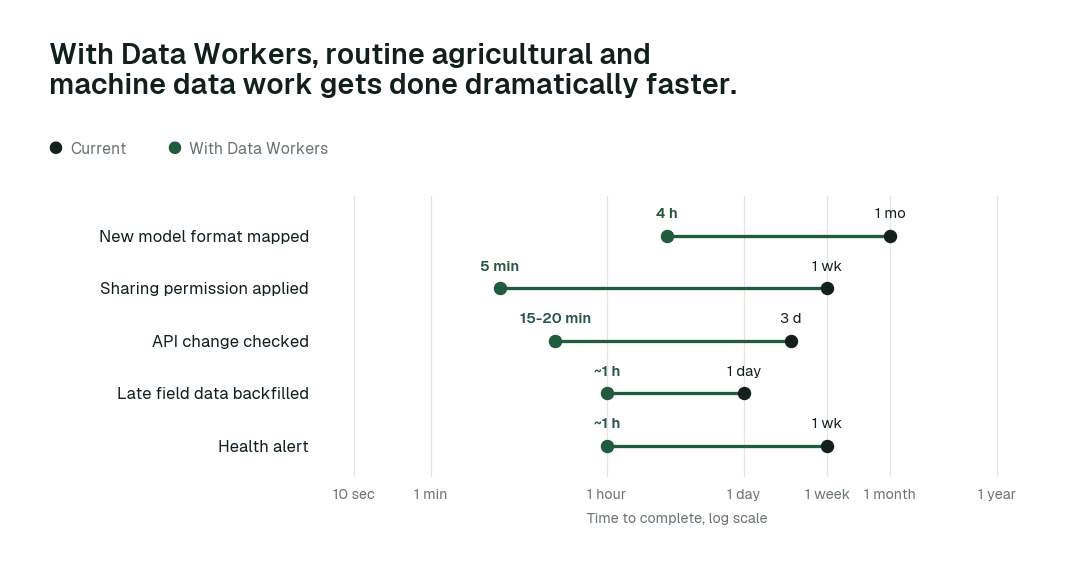
- •Sharing permission applied: from about a week to 5 min
- •API change checked: from about 3 days to 15-20 min
- •New model format mapped: from about a month to hours
Across the routine work:
Use cases, in depth
Yield maps on day one of a new model
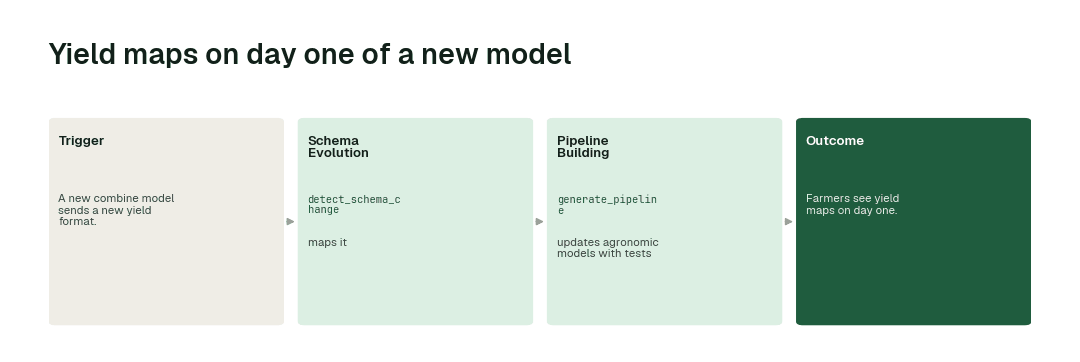
Today. A new combine model sends a new yield format.
With Data Workers. Schema Evolution maps it; Pipeline Building updates agronomic models with tests.
What changes. Farmers see yield maps on day one. Read the playbook.
Farmer-controlled sharing
Today. A farmer shares field data with an agronomist.
With Data Workers. Data Access & Governance enforces the permission scope and logs it.
What changes. Sharing is instant and auditable. Read the playbook.
Partner APIs that never break
Today. An internal change breaks partner apps.
With Data Workers. Schema Evolution versions the contract and flags consumers before release.
What changes. Partners never break. Read the playbook.
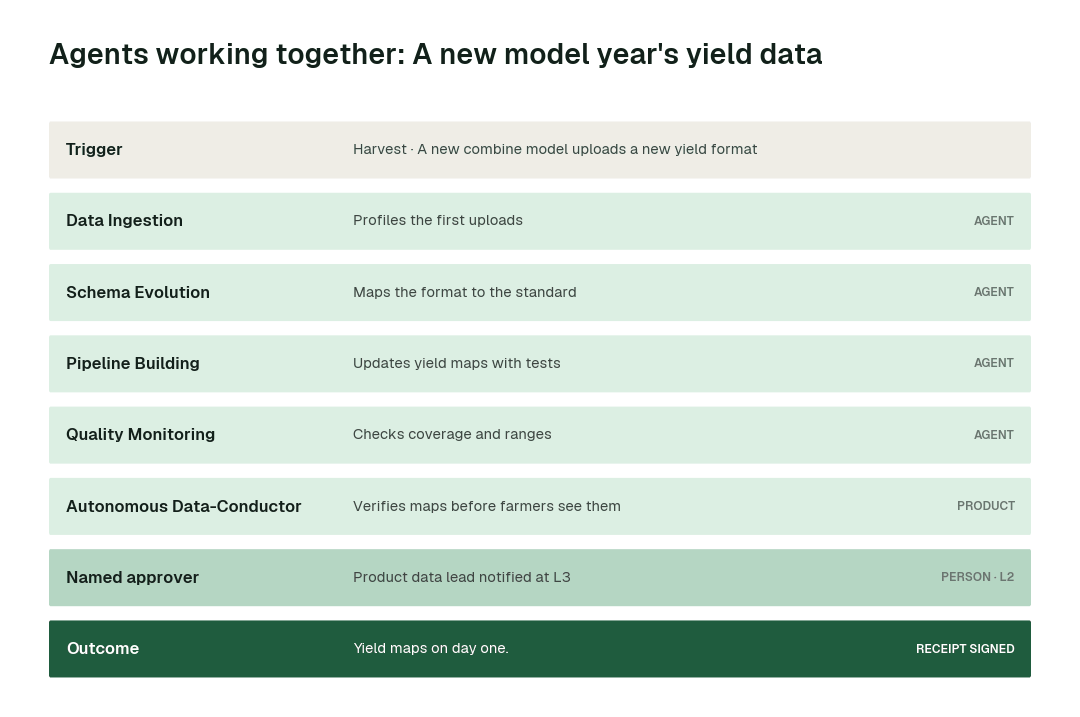
Agents working together: A new model year's yield data
Minute by minute
Illustrative example. Machine uploads land in a cloud lake; yield maps publish to an operations center.
| Time | Who | What happens |
|---|---|---|
| 08:00 | Combine | First uploads in new format |
| 08:05 | Data Ingestion agent | Format profiled; deviations found |
| 08:30 | Autonomous Data-Conductor | Mapping and tests |
| 09:00 | Operations center | Yield maps published |
How it fits your stack
Data Workers connects to what you already run: IoT ingestion; cloud lakes on AWS or Azure; Databricks or Snowflake; partner APIs; operations center applications. Each agent is an MCP server, so the same agents work inside Claude Code, Cursor or Codex and in Slack or Teams through Spellbook. Nothing migrates.
- •Runs in your infrastructure with your credentials and your model key. The hosted Autonomous Data-Conductor sees workflow metadata only, never rows.
- •Uses the access you already govern. Agents act under scoped service identities and your existing roles; every grant goes through provision_access and is logged.
- •Proposes changes as diffs in your dbt project, orchestrator and warehouse, with blast radius, tests and a rollback point, and applies them only at the autonomy level you set for that domain.
- •Open-source core. The Apache-2.0 community edition ships 11 agents and 160+ MCP tools, so your engineers can read exactly what the agents call.
How autonomy expands over the first year
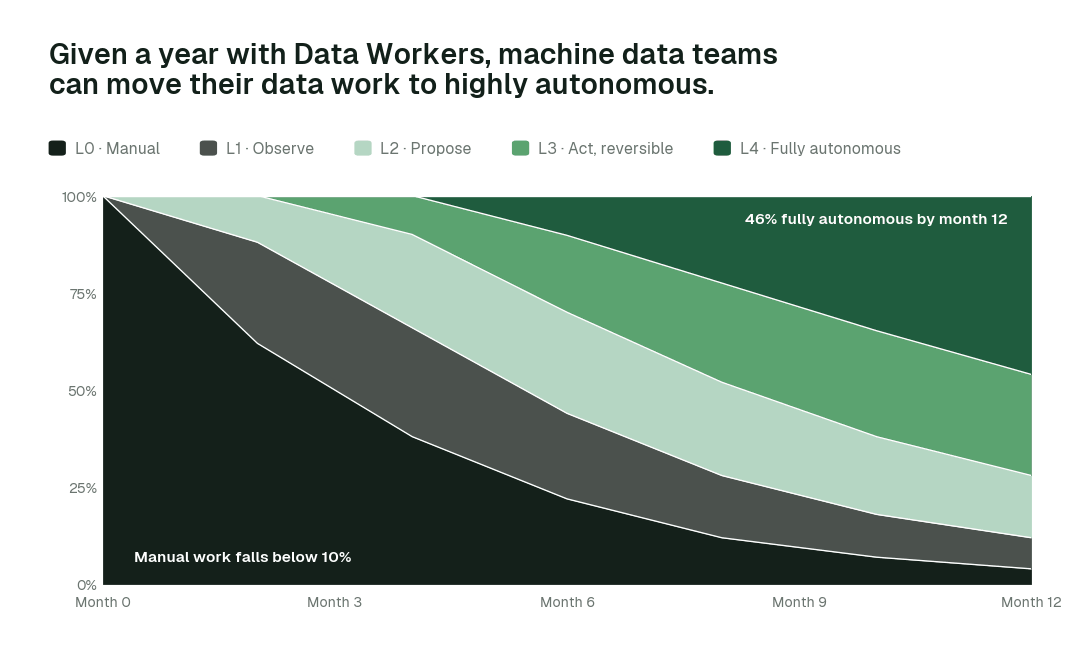
Autonomy is earned per task class. In a mature deployment, it looks like this:
A typical path: month 1 at L1 everywhere; months 2 to 3, L3 and L4 on reversible upkeep; months 4 to 6, new data products built by the swarm; months 6 to 12, wider autonomy where the evidence supports it, with regulated or customer-facing numbers kept at L2.
What happens when an agent is wrong
- •At L2 propose, nothing changes until a named person approves. The proposal shows the full diff, the blast radius and how to roll it back. Unanswered requests expire and escalate.
- •At L3 act, reversibly, every change keeps a rollback point, and Conductor verifies the downstream number after the change. If verification fails, the change is reversed and the domain drops a level.
- •No agent approves or promotes its own work. Autonomy only grows on evidence, per repair class, and repeated errors shrink scope automatically.
- •One org-wide stop halts all autonomous dispatch, and every action lands in a hash-chained audit trail you can export with generate_audit_report.
Governance and regulation
Customers own and control sharing of their data. Data Workers enforces permissions in the data and logs every share.
Data Workers doesn't make you compliant; your controls, people and assessors do. It supplies controls and evidence wherever agents touch data. Not legal advice.
The alternatives agriculture and industrial data teams weigh
Build it yourselves. A strong team can wire a coding agent to MCP servers for the warehouse and dbt. The work is everything around it: routing approvals to the right owner, blast radius, rollback, receipts, and current context about every other system.
Observability, catalogs and point tools. Observability alerts, catalogs document, and quality tools test. Data Workers takes their signals, diagnoses, proposes the fix, verifies it and leaves the receipt.
Platform-native agents. Snowflake made its managed MCP server and Cortex Agents generally available on Nov 4, 2025, and Databricks made Genie One generally available on Jun 16, 2026. They are excellent inside their platform; this work crosses the source systems, orchestrator, warehouse and BI, and Data Workers works across all of them.
In this space specifically. IoT platforms collect telemetry; Data Workers maps, verifies and governs it into products.
The case for your CTO
What this replaces. The week spent on converter backlogs and manual sharing.
What your teams get back. Time for machine data services that work on day one, on data that is verified before anyone reads it.
Integration effort. Connecting is configuration, not a migration. The agents attach over MCP to the platforms you already run, under the roles you already govern, inside your own infrastructure.
Risk and control. Autonomy is set per domain, starts at L1 and rises only on evidence. Regulated and customer-facing numbers stay at L2 with a named approver, and one org-wide stop halts all autonomous work.
Why now. Data-driven services drive equipment value.
The first win. Format mapping on one product line. The pilot below lays out the scope, what you see each week and the cost.
The climb: from assisted to autonomous to agentic
Our thesis is that the data platform climbs the way analytics did, in stages. In agriculture and industrial, that climb looks like this:
- •Assisted. Agents work alongside each data team, read the whole stack and propose every fix with a receipt. Regulated and customer-facing numbers always go to a named approver.
- •Autonomous, under your governance. The upkeep behind converter backlogs and manual sharing runs on its own, domain by domain, as the receipts earn it.
- •The agentic enterprise. The platform largely runs itself. People set direction and standards, and the teams spend their time on machine data services that work on day one.
You choose the altitude, every step is visible and reversible, and the pilot below is the first rung.
The pilot: how agriculture and industrial data teams start
The pilot is how a team proves the value on its own data before committing.
- •What we connect. IoT ingestion; cloud lakes on AWS or Azure; Databricks or Snowflake; partner APIs; operations center applications, over MCP, inside your infrastructure. Nothing migrates.
- •Scope. Format mapping on one product line.
- •First week. Agents run at L1 and show the fixes they would have made, with receipts.
- •By week two. Reversible upkeep (reruns, staging fixes, documentation, cleanup) runs on its own; regulated and customer-facing numbers stay at L2 with a named approver.
- •At day 30. We review the impact metrics against your baseline:
- •Sharing permission applied: from about a week to 5 min
- •API change checked: from about 3 days to 15-20 min
- •New model format mapped: from about a month to hours
- •the share of catalog upkeep closed autonomously, targeting 88%
- •What you decide. Which domain or team goes next. The pilot fee is credited in full against the first year.
- •Cost. Start with a pilot ($7,500 one-time, credited in full against the first year). Scale is from $1,000 a month and Enterprise from $3,000 a month, billed annually, with unlimited seats, no usage meter and no markup on model spend. See pricing.
Teams we work with in agriculture and industrial
FAQ
Does it handle edge uploads? Yes.
Can customers revoke sharing? Yes, enforced and logged.
Does it protect partner APIs? Contracts are versioned.
Where do the agents run? In your infrastructure, with your credentials and model key. The hosted Conductor sees workflow metadata only.
Do we have to migrate anything? No. Your warehouse, dbt project, orchestrator, catalog and BI stay where they are.
Sources
- •OEM Off-Highway, John Deere open data platform: https://www.oemoffhighway.com/engineering-manufacturing/software/press-release/12251295/john-deere-opens-data-platform-to-other-software-suppliers
- •Data Workers pricing: https://dataworkers.io/pricing/
- •Data Workers open-source repository (tool registrations): https://github.com/DataWorkersProject/dataworkers-claw-community
- •Snowflake, managed MCP server and Cortex Agents GA release note (Nov 4, 2025): https://docs.snowflake.com/en/release-notes/2025/other/2025-11-04-cortex-agents-mcp
- •Databricks, Genie One launch (Jun 16, 2026): https://www.databricks.com/company/newsroom/press-releases/databricks-launches-genie-one-all-new-agentic-coworker-every-team