A playbook for data leaders at AI labs and model builders
If you are a data leader at an AI lab or model builder, this is your playbook. It covers what your team ships, where its week goes today, the use cases agents take over first, the autonomy you can safely grant in each domain, and what to show leadership after the first quarter.
Key takeaways
- •Who this is for. Data leaders and teams at AI labs, model builders and AI data companies.
- •The problem today. Most of the data team's week goes to manual vetting, rights spreadsheets and contamination surprises.
- •What changes. Specialised agents take that work over across the systems you already run: they catch bad data where it enters, fix it where it lives and verify the number before anyone reads it.
- •What stays with your people. Anything regulated or customer-facing waits for a named approver with the full diff, blast radius and rollback plan in front of them.
- •The result. Data teams that spend their time on more usable data and models you can defend.
The PRD for agentic data in AI and foundation model
This is the requirements document we would write with you. Everything below expands on it.
| Who | Data leaders and teams at AI labs, model builders and AI data companies. |
| The job | The data pipeline that scales models. |
| Environment | Seller data rooms and buckets; object storage; Spark or Ray; dedup and filter pipelines; training run trackers; eval stores, and the other platforms your teams run. |
| Constraints | Regulated and customer-facing numbers always go to a named approver; agents run in your infrastructure under the roles you already govern. |
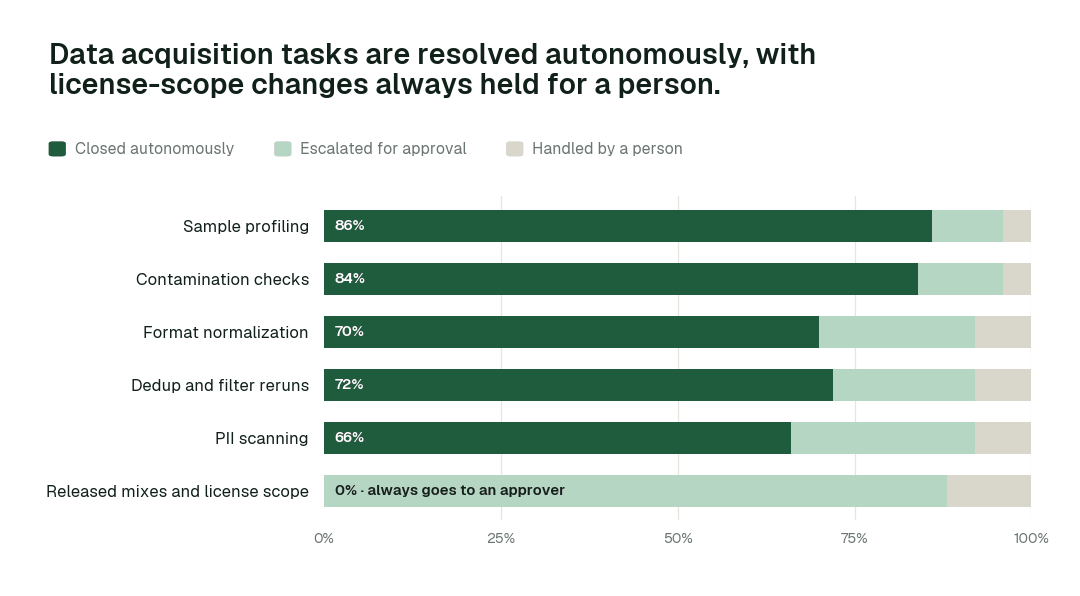
| Success is measured by | Asset traced to eval delta: from about 2 days to seconds; License change enforced: from about 2 weeks to ~1 h; Duplicate corpus copies retired: from about a month to hours; sample profiling closed autonomously 86% of the time. |
| Owned by | The head of data or CDO, with domain owners as named approvers. |
| Pilot scope | Vet the next three acquisitions and gate one training mix. |
What going fully agentic and autonomous means in AI and foundation model
- •Put your data pipelines on autopilot. Agents catch bad data where it enters, fix it where it lives and verify the number before anyone reads it.
- •Run the data back office without the busywork. The week that goes to manual vetting, rights spreadsheets and contamination surprises moves to agents.
- •Scale data without scaling headcount. New sources, partners and data products are onboarded as missions, not projects.
- •Get the plumbing off your plate. Data teams spend their time on more usable data and models you can defend.
The shift
Scaling laws turned data into the scarce input. Labs buy proprietary assets, generate synthetic data, collect human feedback and log fleets of robots, and every source carries rights, privacy and contamination risk. The data teams behind models are small relative to the compute they feed.
Our view: the path from acquired asset to measured model gain should be one governed pipeline run by agents, with people deciding what to buy, what to train on and what to release.
A day on a AI and foundation model data team today
A seller's sample sits in a data room awaiting two weeks of profiling. A licensor narrows a license and nobody can say which models are affected. A labeling vendor misses a spec change and bad labels reach a training set. An eval set leaks into a mix and the latest benchmark gain is partly fake.
That week is typical, not exceptional. Here is where the time goes, today and with agents on the back office:
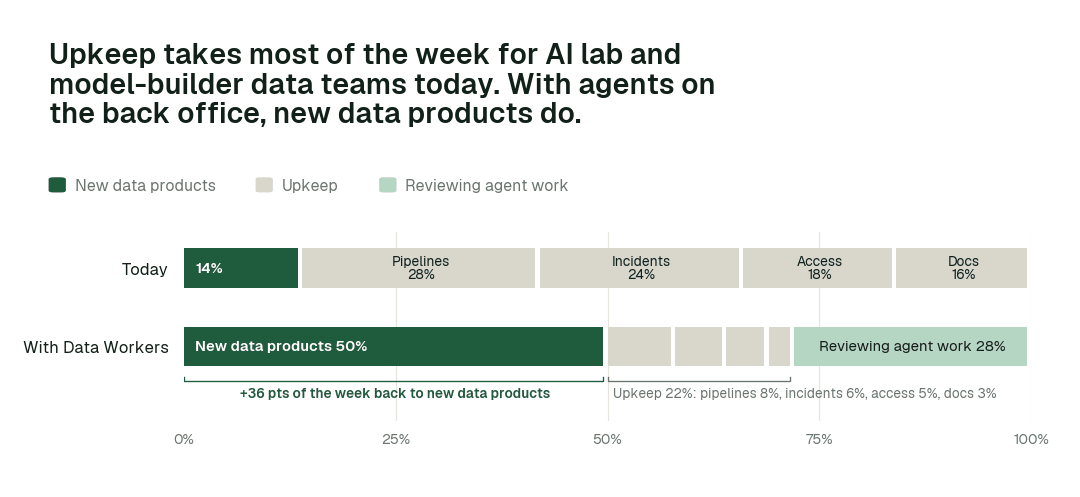
Then and now
| Work | Today | With Data Workers |
|---|---|---|
| Vetting acquired data | Two weeks per sample | Hours, on unique usable tokens |
| Rights and licenses | Spreadsheets | Enforced on every run |
| Label quality | Spot checks | Gated per batch |
| Eval contamination | Found after release | Checked before every run |
| Corpus cost | A copy per experiment | Deduplicated and tiered |
These are the impact metrics we move:
- •Asset traced to eval delta: from about 2 days to seconds
- •License change enforced: from about 2 weeks to ~1 h
- •Duplicate corpus copies retired: from about a month to hours
Across the routine work:
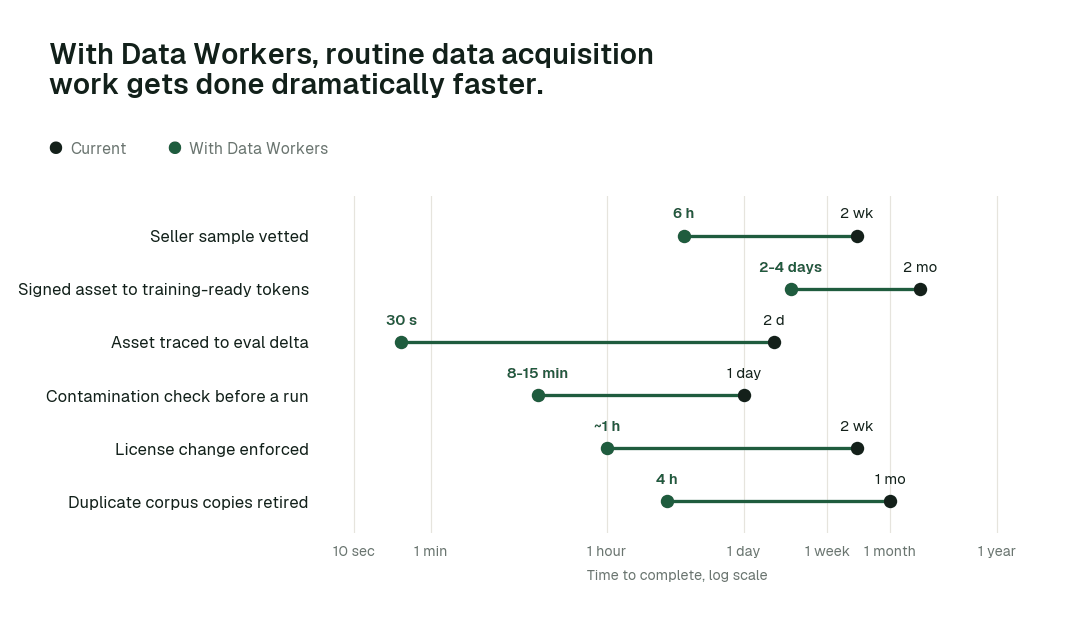
Use cases, in depth
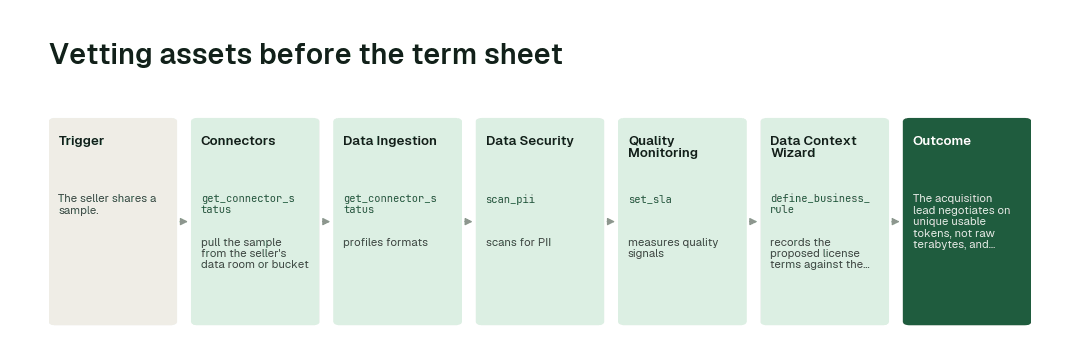
Vetting assets before the term sheet
Today. The seller shares a sample. Engineers pull it, write one-off scripts to profile it, researchers read examples, legal reviews the license draft. Two weeks later the team has an opinion, but not the number that matters: how many genuinely new, usable tokens are in it.
With Data Workers. Connectors pull the sample from the seller's data room or bucket. Data Ingestion profiles formats, volumes and languages. Data Security scans for PII and sensitive content. Quality Monitoring measures quality signals, near-duplicate overlap with your existing corpus and contamination with your eval sets. Data Context Wizard records the proposed license terms against the asset. Autonomous Data-Conductor assembles a vetting report: estimated unique usable tokens, quality distribution, PII exposure and license flags.
What changes. The acquisition lead negotiates on unique usable tokens, not raw terabytes, and walks away from assets that mostly duplicate what the lab already owns. Read the playbook.
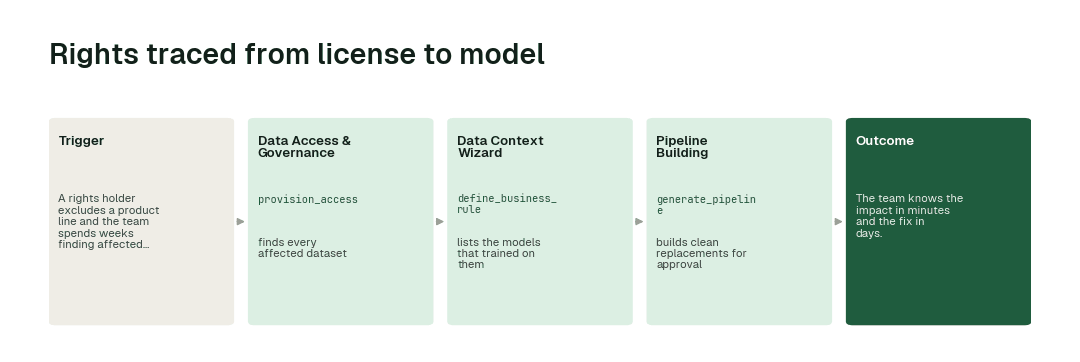
Rights traced from license to model
Today. A rights holder excludes a product line and the team spends weeks finding affected assets.
With Data Workers. Access & Governance finds every affected dataset and mix, Context Wizard lists the models that trained on them and Pipeline Building builds clean replacements for approval.
What changes. The team knows the impact in minutes and the fix in days. Read the playbook.
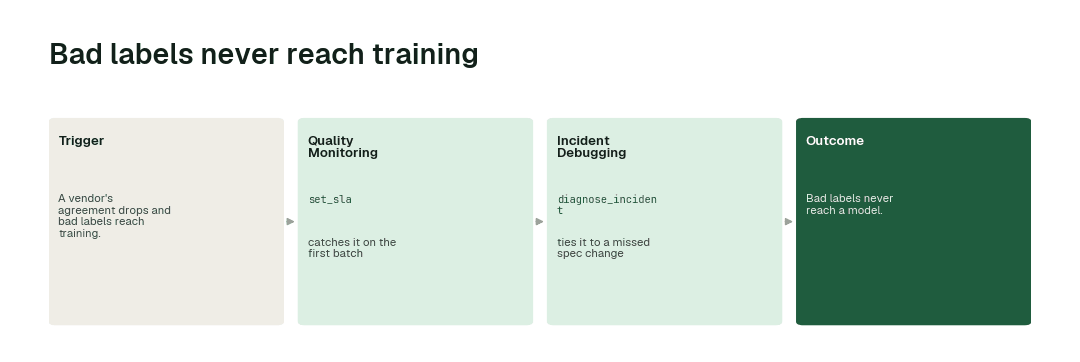
Bad labels never reach training
Today. A vendor's agreement drops and bad labels reach training.
With Data Workers. Quality Monitoring catches it on the first batch, Incident Debugging ties it to a missed spec change, the batch is quarantined and one decision goes to the data lead.
What changes. Bad labels never reach a model. Read the playbook.
Agents working together: A seller's 40 TB asset, vetted before the term sheet
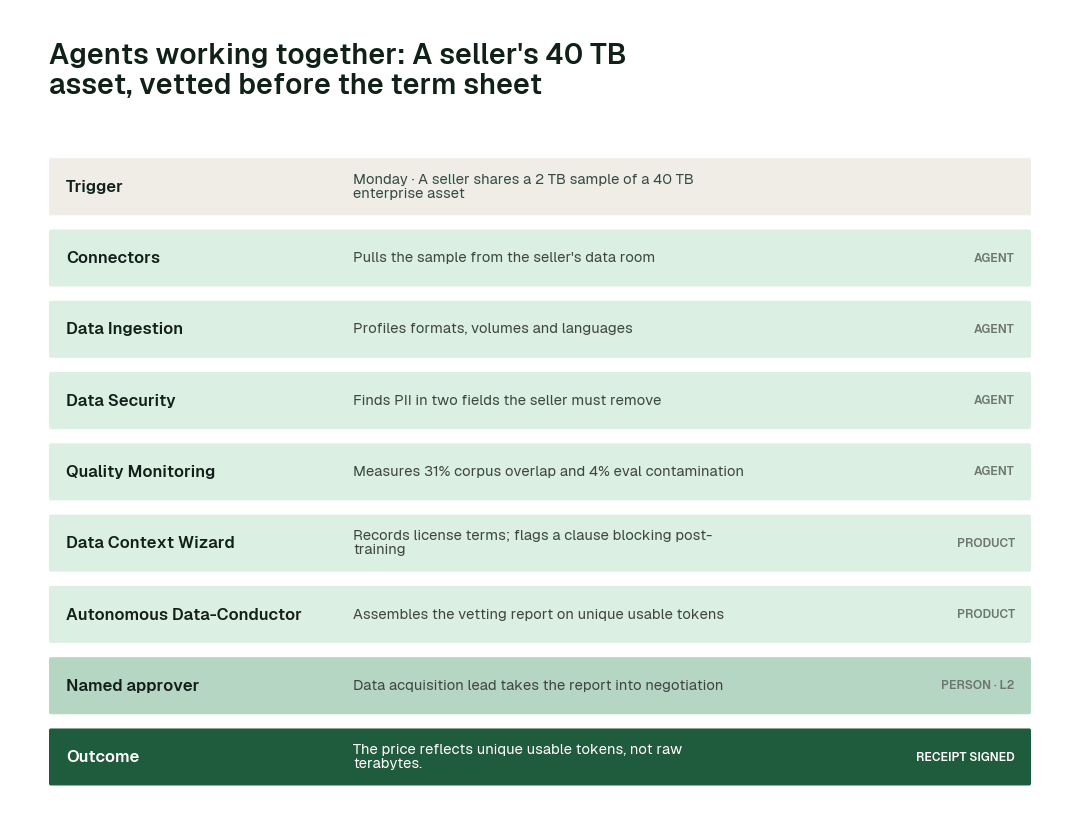
Minute by minute
Illustrative example. A seller shares a 2 TB sample of a 40 TB asset.
| Time | Who | What happens |
|---|---|---|
| Mon 09:00 | Seller | Sample shared |
| 09:30 | Data Ingestion agent | Formats, volumes and languages profiled |
| 11:00 | Data Security agent | scan_pii: two fields with PII |
| 13:00 | Quality Monitoring agent | 31% corpus overlap, 4% eval contamination |
| 15:00 | Quality Monitoring agent | License clause blocking post-training flagged |
| 17:00 | Spellbook Data Catalog | Vetting report to the acquisition lead |
How it fits your stack
Data Workers connects to what you already run: Seller data rooms and buckets; object storage; Spark or Ray; dedup and filter pipelines; training run trackers; eval stores. Each agent is an MCP server, so the same agents work inside Claude Code, Cursor or Codex and in Slack or Teams through Spellbook. Nothing migrates.
- •Runs in your infrastructure with your credentials and your model key. The hosted Autonomous Data-Conductor sees workflow metadata only, never rows.
- •Uses the access you already govern. Agents act under scoped service identities and your existing roles; every grant goes through provision_access and is logged.
- •Proposes changes as diffs in your dbt project, orchestrator and warehouse, with blast radius, tests and a rollback point, and applies them only at the autonomy level you set for that domain.
- •Open-source core. The Apache-2.0 community edition ships 11 agents and 160+ MCP tools, so your engineers can read exactly what the agents call.
How autonomy expands over the first year
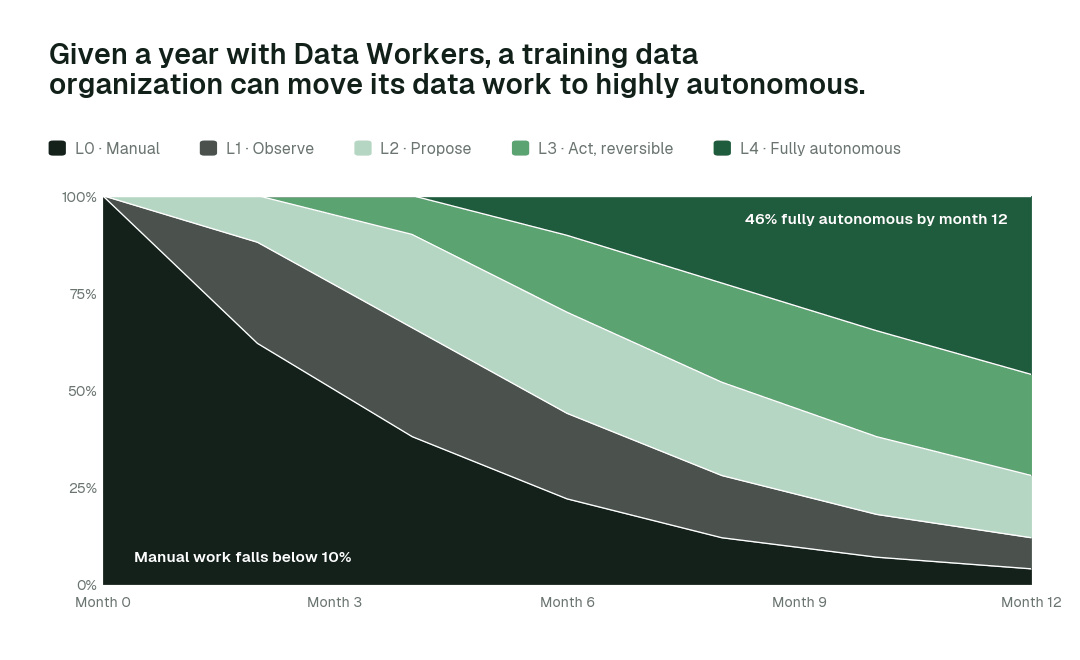
Autonomy is earned per task class. In a mature deployment, it looks like this:
A typical path: month 1 at L1 everywhere; months 2 to 3, L3 and L4 on reversible upkeep; months 4 to 6, new data products built by the swarm; months 6 to 12, wider autonomy where the evidence supports it, with regulated or customer-facing numbers kept at L2.
What happens when an agent is wrong
- •At L2 propose, nothing changes until a named person approves. The proposal shows the full diff, the blast radius and how to roll it back. Unanswered requests expire and escalate.
- •At L3 act, reversibly, every change keeps a rollback point, and Conductor verifies the downstream number after the change. If verification fails, the change is reversed and the domain drops a level.
- •No agent approves or promotes its own work. Autonomy only grows on evidence, per repair class, and repeated errors shrink scope automatically.
- •One org-wide stop halts all autonomous dispatch, and every action lands in a hash-chained audit trail you can export with generate_audit_report.
Governance and regulation
Training data carries copyright, license and privacy obligations, and AI regulation increasingly expects documented provenance. Data Workers records provenance and terms, enforces scope and logs every use.
Data Workers doesn't make you compliant; your controls, people and assessors do. It supplies controls and evidence wherever agents touch data. Not legal advice.
The alternatives AI and foundation model data teams weigh
Build it yourselves. A strong team can wire a coding agent to MCP servers for the warehouse and dbt. The work is everything around it: routing approvals to the right owner, blast radius, rollback, receipts, and current context about every other system.
Observability, catalogs and point tools. Observability alerts, catalogs document, and quality tools test. Data Workers takes their signals, diagnoses, proposes the fix, verifies it and leaves the receipt.
Platform-native agents. Snowflake made its managed MCP server and Cortex Agents generally available on Nov 4, 2025, and Databricks made Genie One generally available on Jun 16, 2026. They are excellent inside their platform; this work crosses the source systems, orchestrator, warehouse and BI, and Data Workers works across all of them.
In this space specifically. Curation and labeling tools each own a step; Data Workers connects acquisition, rights, quality and lineage to models.
The case for your CTO
What this replaces. The week spent on manual vetting, rights spreadsheets and contamination surprises.
What your teams get back. Time for more usable data and models you can defend, on data that is verified before anyone reads it.
Integration effort. Connecting is configuration, not a migration. The agents attach over MCP to the platforms you already run, under the roles you already govern, inside your own infrastructure.
Risk and control. Autonomy is set per domain, starts at L1 and rises only on evidence. Regulated and customer-facing numbers stay at L2 with a named approver, and one org-wide stop halts all autonomous work.
Why now. Data spend now rivals compute in some programs.
The first win. Vet the next three acquisitions and gate one training mix. The pilot below lays out the scope, what you see each week and the cost.
The climb: from assisted to autonomous to agentic
Our thesis is that the data platform climbs the way analytics did, in stages. In AI and foundation model, that climb looks like this:
- •Assisted. Agents work alongside each data team, read the whole stack and propose every fix with a receipt. Regulated and customer-facing numbers always go to a named approver.
- •Autonomous, under your governance. The upkeep behind manual vetting, rights spreadsheets and contamination surprises runs on its own, domain by domain, as the receipts earn it.
- •The agentic enterprise. The platform largely runs itself. People set direction and standards, and the teams spend their time on more usable data and models you can defend.
You choose the altitude, every step is visible and reversible, and the pilot below is the first rung.
The pilot: how AI and foundation model data teams start
The pilot is how a team proves the value on its own data before committing.
- •What we connect. Seller data rooms and buckets; object storage; Spark or Ray; dedup and filter pipelines; training run trackers; eval stores, over MCP, inside your infrastructure. Nothing migrates.
- •Scope. Vet the next three acquisitions and gate one training mix.
- •First week. Agents run at L1 and show the fixes they would have made, with receipts.
- •By week two. Reversible upkeep (reruns, staging fixes, documentation, cleanup) runs on its own; regulated and customer-facing numbers stay at L2 with a named approver.
- •At day 30. We review the impact metrics against your baseline:
- •Asset traced to eval delta: from about 2 days to seconds
- •License change enforced: from about 2 weeks to ~1 h
- •Duplicate corpus copies retired: from about a month to hours
- •the share of sample profiling closed autonomously, targeting 86%
- •What you decide. Which domain or team goes next. The pilot fee is credited in full against the first year.
- •Cost. Start with a pilot ($7,500 one-time, credited in full against the first year). Scale is from $1,000 a month and Enterprise from $3,000 a month, billed annually, with unlimited seats, no usage meter and no markup on model spend. See pricing.
Teams we work with in AI and foundation model
FAQ
Can it trace a model to its data? Yes, through lineage.
Does it run on our clusters? Agents run in your infrastructure.
Who approves released mixes? A named lead at L2.
Where do the agents run? In your infrastructure, with your credentials and model key. The hosted Conductor sees workflow metadata only.
Do we have to migrate anything? No. Your warehouse, dbt project, orchestrator, catalog and BI stay where they are.
Sources
- •AfterQuery, Data Acquisition Lead: https://jobs.ashbyhq.com/AfterQuery/8041b75b-aeda-4363-be56-87ecabef682b
- •OpenAI, Software Engineer, Research Human Data: https://openai.com/careers/software-engineer-research-human-data/
- •Data Workers pricing: https://dataworkers.io/pricing/
- •Data Workers open-source repository (tool registrations): https://github.com/DataWorkersProject/dataworkers-claw-community
- •Snowflake, managed MCP server and Cortex Agents GA release note (Nov 4, 2025): https://docs.snowflake.com/en/release-notes/2025/other/2025-11-04-cortex-agents-mcp
- •Databricks, Genie One launch (Jun 16, 2026): https://www.databricks.com/company/newsroom/press-releases/databricks-launches-genie-one-all-new-agentic-coworker-every-team