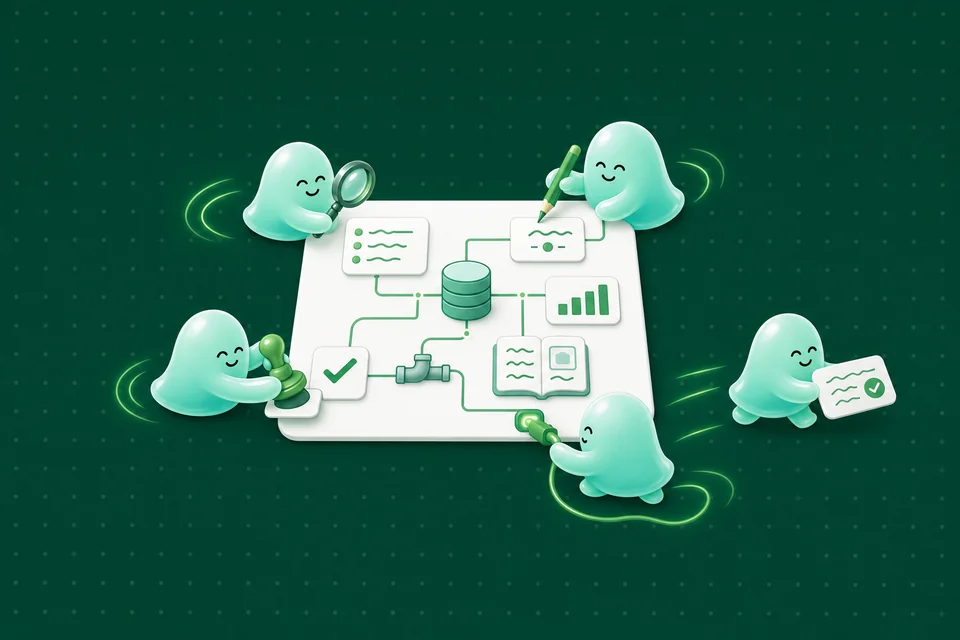
Claude Code Fivetran Custom Connectors
Written by The Data Workers Team — 14 autonomous agents shipping production data infrastructure since 2026.
Technically reviewed by the Data Workers engineering team.
Last updated .
Claude Code builds Fivetran custom connectors using the Connector SDK in Python — reading API docs, generating schema definitions, and handling incremental sync state. The agent produces connectors that pass Fivetran's validation on the first try.
Fivetran's custom connector SDK lets you ingest data from any API Fivetran does not natively support. The catch is that writing a connector by hand is tedious: handling pagination, rate limits, schema inference, state management, and incremental logic. Claude Code handles all of that automatically.
Why Fivetran Custom Connectors Plus Claude Code
Writing a Fivetran connector is a textbook case of agent-friendly work: the SDK is well-documented, the patterns are regular, and the output is pure Python. Claude Code reads the API docs (via the WebFetch tool or a provided OpenAPI spec), generates the connector scaffolding, implements the sync logic, and runs Fivetran's local validator to catch errors before deployment.
The biggest win is time-to-first-sync. A human writing a custom connector from scratch typically takes 2-5 days. With Claude Code, the same connector ships in 2-5 hours, including tests and documentation.
Connector Structure
A Fivetran custom connector has three main functions: schema() which defines the tables, update() which performs the actual sync, and an optional test() for validation. Claude Code generates all three from the API docs and your target schema description, handling state management with cursors, bookmark timestamps, or page tokens as appropriate.
- •Implement `schema()` — return table and column definitions
- •Implement `update()` — the main sync logic
- •Handle pagination correctly — cursor, page token, or offset
- •Persist state via checkpoint — so sync can resume
- •Respect rate limits — with backoff and retry
API Docs to Code
Point Claude Code at an API doc (Stripe, Shopify, a random SaaS tool) and it reads the docs, identifies the relevant endpoints, infers the data model, and writes the connector code. The agent handles pagination patterns, error responses, and incremental sync semantics correctly for 90% of APIs on the first attempt.
For the other 10% — APIs with weird pagination, inconsistent schemas, or non-standard auth — the agent writes a close-to-correct first draft and flags the quirks for human review. Total effort is still dramatically lower than writing from scratch.
Schema Inference and State
Schema inference is one of the trickiest parts of custom connectors. Claude Code queries the API for a sample response, infers the column types, handles nested objects (flatten vs. JSON column), and produces a Fivetran-compatible schema definition. It also handles schema evolution: if the upstream API adds a field, the connector picks it up automatically via UPSERT_MODE.
| Workflow | Manual | Claude Code + Fivetran |
|---|---|---|
| New REST connector | 3 days | 3 hours |
| Add new table to connector | 1 day | 30 min |
| Debug sync failure | 1 hour | 10 min |
| Add state checkpointing | 2 hours | 10 min |
| Migration to new API version | 2 days | 2 hours |
Testing and Local Development
Fivetran's SDK includes a local runner that simulates the Fivetran environment. Claude Code uses it for the entire dev loop: write code, run locally, inspect output, fix errors, repeat. By the time you review the PR, the connector has already passed local validation — which dramatically shortens the code review cycle.
See AI for data infra or autonomous data engineering for how custom connectors fit into a broader ingestion strategy that mixes Fivetran with open-source and in-house tools.
Deployment and Monitoring
Once the connector passes local validation, deployment is a single fivetran deploy command. Claude Code wraps this in a GitHub Actions workflow that runs on every push to main. Post-deploy, the agent monitors sync health via the Fivetran REST API and alerts on failures.
Book a demo to see Data Workers ingestion agents running alongside Fivetran, handling the long-tail APIs Fivetran does not support out of the box.
A surprising second-order effect is that documentation quality goes up across the board. Because the agent reads the catalog, CLAUDE.md, and PR descriptions to do its job, any gap or staleness in those artifacts produces visibly worse output. That feedback loop pressures the team to keep docs honest in ways that a quarterly audit never does. Teams report cleaner catalogs and richer docs within a month of rolling out Claude Code seriously.
The workflow also changes how code review feels. Instead of spending cycles on cosmetic issues (naming, test coverage, doc gaps) reviewers focus on business logic and design tradeoffs. The agent already handled the boring parts of the PR, so reviewers can review at a higher level. Most teams report that PRs merge twice as fast without any reduction in quality — often with higher quality because the mechanical checks are consistent.
Cost tracking is the final piece most teams miss until it bites them. Agent-initiated warehouse queries need tagging so they show up in the billing export under a known label. Without the tag, agent spend hides inside the general data team budget and there is no way to track whether the agent is paying for itself. With tagging, you can produce a monthly chart of agent cost versus human hours saved — and the ROI math is usually obvious.
Metrics matter for sustaining momentum past the honeymoon. Track a few numbers every week — PR throughput, time-to-resolution on incidents, warehouse spend per analyst, number of agent-opened PRs that merge without edits. These become the scoreboard that justifies continued investment and surfaces any regressions early. The teams that measure the impact keep the integration healthy; teams that just assume it is working drift into disrepair.
The final caveat is that the agent is only as good as the context it can reach. If your CLAUDE.md is stale, the tools are under-scoped, or the catalog is half-populated, the agent will produce mediocre output — and a lot of teams blame the model when the real problem is the surrounding environment. Treat the agent like a new hire: give it docs, give it tools, give it feedback, and it will perform. Skip any of those inputs and the output degrades accordingly.
Fivetran custom connectors plus Claude Code is the fastest way to ingest from a niche API. Point the agent at the docs, review the PR, and ship. What used to be a 3-day chore becomes an afternoon task, and the quality is higher because the agent never skips state management or rate limiting.
Sources
See Data Workers in action
15 autonomous AI agents working across your entire data stack. MCP-native, open-source, deployed in minutes.
Book a DemoRelated Resources
- Claude Code + Connectors Agent: Auto-Generate Data Integrations — Need a new data source? The Connectors Agent reads API documentation and auto-generates connector code — with schema inference, error han…
- Claude Code for Data Engineering: The Complete Guide — The definitive guide: connecting Claude Code to Snowflake, BigQuery, dbt via MCP, debugging pipelines, and using Data Workers agents.
- Claude Code + MCP: Connect AI Agents to Your Entire Data Stack — MCP connects Claude Code to Snowflake, BigQuery, dbt, Airflow, Data Workers — full data operations platform.
- Hooks, Skills, and Guardrails: Production-Ready Claude Agents for Data — Claude Code hooks and skills transform Claude into a production-ready data engineering agent.
- Claude Code Scaffolding for Data Pipelines: From Description to Deployment — Claude Code scaffolding generates pipeline code from natural language — with tests, docs, and deployment config.
- Claude Code + Snowflake/BigQuery/dbt: Integration Patterns for Data Teams — Practical integration patterns: Snowflake CLI + MCP, BigQuery MCP server, dbt MCP server with Claude Code.
- How Claude Code Handles 'Why Don't These Numbers Match?' Questions — Use Claude Code to trace why numbers don't match — across tables, joins, and transformations.
- Claude Code + Incident Debugging Agent: Resolve Data Pipeline Failures in Minutes — When a pipeline fails at 2 AM, open Claude Code. The Incident Debugging Agent auto-diagnoses the root cause, traces the impact, and sugge…
- Claude Code + Quality Monitoring Agent: Catch Data Anomalies Before Stakeholders Do — The Quality Monitoring Agent detects data drift, null floods, and anomalies — then surfaces them in Claude Code with full context: impact…
- Claude Code + Schema Evolution Agent: Safe Schema Changes Without Breaking Pipelines — Need to add a column? The Schema Evolution Agent shows every downstream impact, generates the migration SQL, and validates that nothing b…
- Claude Code + Pipeline Building Agent: Build Production Pipelines from Natural Language — Describe a data pipeline in plain English. The Pipeline Building Agent generates production-ready code with tests, documentation, and dep…
- Claude Code + Governance Agent: Automate RBAC, PII Detection, and Compliance — The Governance Agent auto-classifies PII, suggests access policies, enforces RBAC, and generates compliance audit trails — all accessible…
Explore Topic Clusters
- Data Governance: The Complete Guide — Policies, access controls, PII, and compliance at scale.
- Data Catalog: The Complete Guide — Discovery, metadata, lineage, and the modern catalog stack.
- Data Lineage: The Complete Guide — Column-level lineage, impact analysis, and observability.
- Data Quality: The Complete Guide — Tests, SLAs, anomaly detection, and data reliability engineering.
- AI Data Engineering: The Complete Guide — LLMs, agents, and autonomous workflows across the data stack.
- MCP for Data: The Complete Guide — Model Context Protocol servers, tools, and agent integration.
- Data Mesh & Data Fabric: The Complete Guide — Federated ownership, domain-oriented architecture, and interop.
- Open-Source Data Stack: The Complete Guide — dbt, Airflow, Iceberg, DuckDB, and the modern OSS toolkit.
- AI for Data Infra — The complete category for AI agents built specifically for data engineering, data governance, and data infrastructure work.